

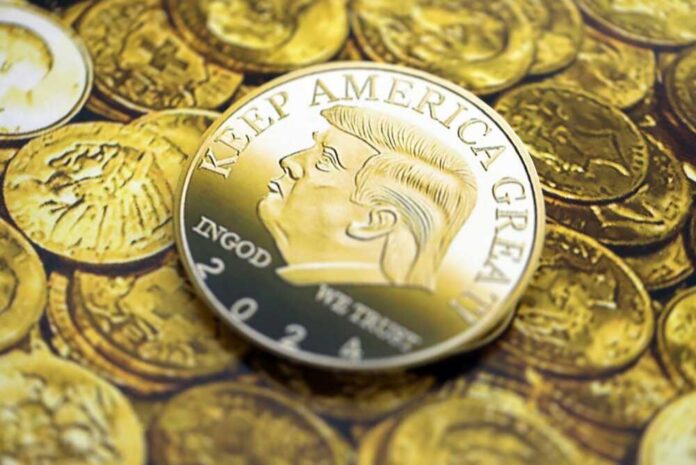
Treasury just used a rarely invoked legal workaround to put a sitting president on a U.S. Mint gold coin—shattering a long-standing “no living person” norm that was meant to keep America’s money from turning into political propaganda.
Quick Take
- The Commission of Fine Arts approved a 24-karat Trump commemorative gold coin design tied to America’s 250th anniversary in 2026.
- Treasury Secretary Scott Bessent relied on statutory bullion authority (31 U.S.C. § 5112) to move forward despite the traditional prohibition on living presidents appearing on U.S. currency.
- The Citizens Coinage Advisory Committee declined to review the design, raising process and precedent questions even as the coin is not intended for circulation.
- The fight is colliding with broader Washington ethics arguments as Treasury also oversees major stablecoin policy work under the GENIUS and CLARITY Act debates.
A Rare Legal Path Clears the Design for Production
The Commission of Fine Arts unanimously approved the coin’s design at a Thursday meeting reported March 20, 2026, clearing a major hurdle for U.S. Mint production. The coin is described as a 24-karat gold commemorative tied to the 250th anniversary of the United States.
Reports indicate Treasury Secretary Scott Bessent invoked the Mint’s discretionary bullion authority under 31 U.S.C. § 5112, an unusual route that allows designs that ordinary currency rules typically avoid.
Gold Trump coin moves forward after Treasury invokes rare authority https://t.co/sR2dU2pQwE
— FOX Business (@FoxBusiness) March 20, 2026
The approved concept is specific and symbolic: the obverse shows President Donald Trump leaning on a desk with “LIBERTY” and “1776–2026,” while the reverse features an eagle with “E PLURIBUS UNUM.”
Media coverage also indicates the coin’s final denomination and size are not settled, with one proposal reaching up to roughly three inches. Importantly, this is framed as a limited-run bullion/commemorative product rather than everyday circulating money.
Why “Not Circulating Currency” Still Doesn’t End the Controversy
Federal practice has long avoided putting living people on U.S. money to reduce politicization, even when leaders are popular with one half of the country.
Supporters point out that a commemorative bullion coin for America 250 is not the same as changing the quarter in your pocket. Critics respond that precedent matters: once a sitting president appears on a government-issued coin, future administrations may push the boundaries further, especially in a polarized era.
The process questions are not limited to partisan reactions. The Citizens Coinage Advisory Committee, an independent advisory group that often weighs in on coin designs, declined to review this one, and reports indicate an acting chair was removed from the agenda.
That matters because it puts more weight on Treasury’s internal discretion and the Commission of Fine Arts’ approval. The Commission itself was reconstituted earlier in 2026 with Trump appointees, adding to scrutiny of how the decision was shaped.
Trump Personally Selected the Design as Treasury Backed the Rollout
Reporting indicates Trump personally reviewed and selected the design from options presented through Treasury Secretary Bessent. U.S. Treasurer Brandon Beach publicly supported the concept, framing it as a patriotic symbol for the semiquincentennial celebration and calling Trump’s profile uniquely emblematic of the moment.
The U.S. Mint’s design management leadership also confirmed the President’s involvement in choosing among the presented designs, underscoring that this was not a routine, low-profile commemorative.
The Coin Fight Lands in the Middle of a Larger Ethics Debate
The coin is also being discussed alongside Treasury’s broader role in financial governance—particularly crypto and stablecoins—because Treasury and its bureaus are shaping or implementing rules as this high-profile commemorative moves forward.
Coverage ties this to the debate over the GENIUS Act and the CLARITY Act, in which Democrats have pushed ethics guardrails to prevent public officials from profiting from crypto-related ventures. Republicans and the White House have rejected claims of conflict, while Democrats argue the overlap raises perception issues.
The facts available so far show a lawful—but politically loaded—use of discretion: Treasury relied on a statutory pathway that appears distinct from ordinary currency restrictions, while the arts commission gave formal approval and the independent coinage committee effectively opted out.
For Americans who want government to stay restrained and institutions to remain credible, the key question is less about whether collectors will buy a gold coin and more about whether Washington can keep commemorations from becoming another battlefield for power and precedent.
Sources:
Trump gold coin: Treasury, Bessent, CLARITY Act ethics & financial governance (2026)
Gold Trump coin moves forward after Treasury invokes rare authority
Federal commission approves design for Trump commemorative gold coin