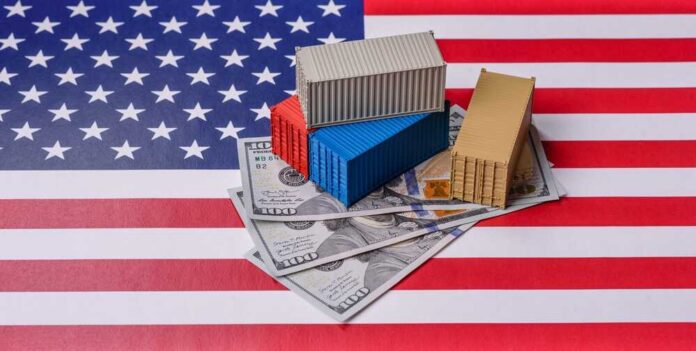
One trade deal that once promised a stronger North America is now the leverage point for a high‑stakes showdown over jobs, sovereignty, and what “America First” really means.
Story Snapshot
- President Trump’s United States-Mexico-Canada Agreement (USMCA) is kept in force but denied long-term renewal.
- The Trump administration rejected automatic extension, triggering years of annual review and uncertainty for businesses.
- Supporters say USMCA boosted American manufacturing and added worker protections; critics say it failed workers.
- The fight exposes a deeper pattern: U.S. leaders use trade deals as tools to pressure allies and control tariffs.
USMCA was sold as a fix, now it is on life support
USMCA replaced the North American Free Trade Agreement in 2020 and kept zero tariffs on almost all trade among the United States, Mexico, and Canada. It added tougher rules of origin for cars and new labor enforcement tools, all pitched as a way to protect American jobs and level the playing field.
The Business Roundtable praised USMCA for securing new provisions that support domestic manufacturing and high-paying American jobs. The Office of the United States Trade Representative itself described the deal as modernized and more balanced.
The Trump administration declined to extend the US-Mexico-Canada Agreement, starting to wind down the trade deal as it seeks changes to try to reshore manufacturing jobs and reduce US trade deficits with its North American neighbors https://t.co/22T3vlcnl0 pic.twitter.com/VGCFFpzffX
— Reuters (@Reuters) July 2, 2026
Congress backed that story. Lawmakers approved USMCA with wide bipartisan margins in both the House and the Senate, larger than the vote totals for many past trade deals, which is rare in today’s fractured politics.
For a moment, it looked like elites on both sides had found a sweet spot: open markets, but with more spine on labor standards and content rules. Business groups pointed to stronger regional supply chains and North American competitiveness as proof that the new deal was working.
Evidence of gains lives next to evidence of failure
Supporters can point to real numbers. Policy researchers report that compliance with USMCA rules by Mexican and Canadian exporters has risen to cover most trade value, which suggests firms adjusted to the new regime instead of dodging it.
The Rapid Response Labor Mechanism, a special enforcement tool in Mexico, has been used to improve wages and conditions for tens of thousands of workers at targeted facilities. These are not minor tweaks; they show the agreement can bite when abuses are clear.
Yet economic researchers at the Economic Policy Institute cast a much harsher verdict. Their review concludes that there is no solid evidence that USMCA has eased the long-term downward pressure on jobs and wages for U.S. manufacturing workers.
They argue the pact still leaves a “back door” open for unfairly traded goods to reach the American market, and that the core problem of offshoring low-wage production remains. From that lens, USMCA looks like another polished promise that failed the very people it claimed to champion.
Trump’s reversal turns his own deal into a bargaining chip
The most jarring twist is that the move against renewal comes not from Democrats, but from the same Trump camp that created USMCA.
On July 1, 2026, the United States formally declined to grant the 16-year automatic extension that USMCA allows, and instead pushed the agreement into a cycle of annual reviews that can last up to a decade.
Trade Representative Jamieson Greer said the administration would not “rubber stamp” the agreement and flagged “substantial issues” with the original deal.
USMCA REVIEW 2026: TRUMP SAYS NO — AND PUTS CANADA AND MEXICO ON NOTICE
On July 1, 2026, the United States officially refused to renew the USMCA.
U.S. Trade Representative Jamieson Greer issued the statement that will reverberate across North America for the next decade:
"The… pic.twitter.com/TvBRZOSNKR
— U.S. & Middle East News 🇺🇸 🇮🇱 🇵🇪 🇨🇴🇬🇧 (@Carlisitus) July 2, 2026
Under the text of USMCA, this choice keeps the pact in force, with all current tariff preferences and rules of origin preserved, but it hangs a cloud over the future. If the three countries fail to settle their differences by 2036, the agreement can terminate and trade would fall back to World Trade Organization terms.
For American conservatives, this approach has a clear logic: keep the benefits for now, but use uncertainty and the threat of tariffs to squeeze better terms out of Mexico and Canada.
Business wants stability; politicians want leverage
Companies that build North American supply chains now face years of “maybe.” Legal analysis notes that firms do not need to change customs filings today, and their current duty-free access remains in place.
At the same time, executives must account for the risk that auto rules, energy provisions, or dispute rules could shift under pressure. Strategic think tanks warn that, in a suboptimal outcome, the United States could force new content thresholds and tariff rate quotas on Mexican and Canadian goods, reshaping investment decisions.
From a common-sense view, the tension is obvious. Long-term deals give businesses the certainty they need to hire, invest, and build factories close to home.
Yet permanent extensions can lock the country into terms that stop serving American workers. By refusing renewal, Trump keeps the option to raise tariffs or demand tougher rules if partners do not play fair. The question is whether this pressure leads to better protections or just more chaos that hurts the same workers it aims to help.
A bigger pattern in U.S. trade politics
The USMCA fight fits a long pattern in United States trade policy. Since the 1930s, Washington has swung between opening markets and slamming on the brakes when voters feel burned by globalization.
NAFTA itself was hailed as a growth engine and then attacked as a job killer, before being rebranded as USMCA with new labor and content rules. Think tanks show that major trade deals almost always face claims that they “failed to protect workers” within a decade, no matter how they were sold.
That history explains why the current review became a stage for hard talk. The Trump team gains bargaining power by holding back renewal and making Mexico and Canada come to the table with concessions.
Critics say this tactic risks blowing up a stable regional framework that has supported hundreds of billions of dollars in trade and investment and helped keep North America competitive against China. Supporters counter that without credible threats, allies and rivals alike treat American complaints as noise, not policy.
Sources:
abcnews.com, nbcnews.com, epi.org, bhfs.com, cfr.org, ustr.gov, businessroundtable.org, en.wikipedia.org, cato.org, usitc.gov