

A pedestrian deliberately scaled Denver International Airport’s perimeter fence and walked into the path of a departing jetliner, igniting an engine fire that forced 231 people to evacuate down emergency slides in a chaos-filled sequence that raises uncomfortable questions about airport security in America’s fifth-busiest air hub.
See the videos below.
Story Snapshot
- Frontier Airlines Flight 4345 struck and killed an unidentified intruder on Runway 17L during takeoff on May 8, 2026, at approximately 11:20 p.m.
- The collision caused partial engine ingestion of the victim, sparking a fire that filled the cabin with smoke and forced emergency evacuation of 224 passengers and 7 crew members.
- Twelve people sustained minor injuries during the slide evacuation, with five requiring hospitalization for evaluation.
- Federal investigators confirmed the pedestrian deliberately jumped the intact perimeter fence, ruling out terrorism but leaving victim identity and motive undisclosed.
- Runway 17L reopened roughly 12 hours later after investigators cleared the scene, while the NTSB launched a full probe into the incident.
When Security Barriers Fail at High Speed
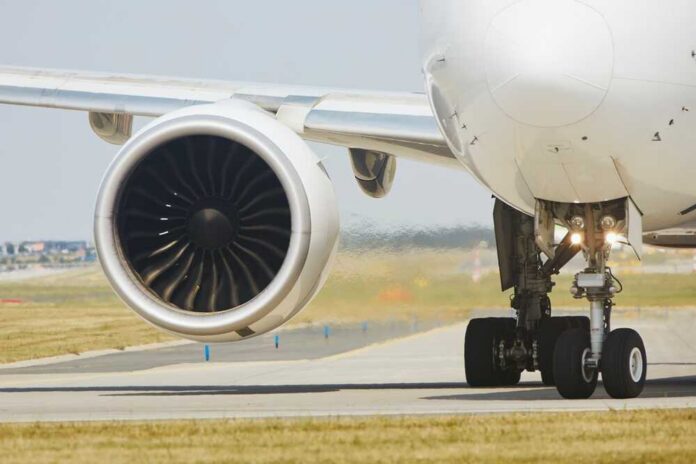
The Airbus A321neo was accelerating toward rotation speed when pilots felt an impact that one crew member described to air traffic control as hitting “somebody.” Within seconds, the left engine erupted in flames as human remains entered the turbofan assembly. Smoke poured into the passenger cabin while the flight deck aborted takeoff and brought the aircraft to a halt on Runway 17L.
Firefighters arrived within minutes to extinguish the blaze, but the pedestrian died instantly upon impact with the jet traveling at speeds approaching 150 miles per hour.
Transportation Secretary Sean Duffy confirmed the intruder deliberately scaled Denver International Airport’s 12 to 15-foot perimeter fence in an area equipped with cameras and regular patrols. The fence showed no signs of damage or prior compromise, suggesting the breach was spontaneous rather than planned.
Denver Police ruled out terrorism immediately but withheld the victim’s identity as investigators probed potential mental health factors. The timing raises questions: DIA had conducted routine fence inspections on a parallel runway earlier that evening, yet no connection to the victim has emerged.
WATCH: New footage shows as Frontier Flight strikes a pedestrian during takeoff at Denver International Airport in Colorado. pic.twitter.com/5UnJ8Hg7ta
— Scope Report (@ScopeReport_) May 9, 2026
Evacuation Under Fire and Smoke
Passenger videos captured terrified travelers sliding down emergency chutes into the darkness as smoke billowed from the engine cowling. Several passengers reported hearing a loud thump followed by alarms and the captain’s urgent command to evacuate. Flight attendants deployed slides on both sides of the fuselage, channeling 231 souls away from the crippled aircraft in under two minutes.
Twelve people suffered scrapes, bruises, and one reported ankle injury from the high-speed slide descent. Five were transported to local hospitals for precautionary evaluation, though none faced life-threatening conditions. Frontier bused the shaken passengers back to the terminal and rebooked most on a later Los Angeles-bound flight.
The crew’s response deserves credit. Aviation safety experts noted that engine fires during high-speed takeoff phases are among the most dangerous scenarios pilots face, yet the Frontier flight deck executed the abort checklist flawlessly. NTSB veterans emphasized that the decision to evacuate immediately rather than taxi back to the gate likely prevented smoke inhalation injuries.
One passenger told local media the crew remained calm and directive despite visible flames outside the windows, a testament to training protocols that prioritize rapid egress over passenger comfort during fire emergencies.
A Pattern Emerging Across American Runways
This incident mirrors troubling precedents at San Francisco International in January 2023 and Los Angeles International in October 2024, where suicidal individuals breached perimeter fencing and were killed by taxiing or departing aircraft.
FAA runway incursion data shows roughly 1,000 serious events annually nationwide, though pedestrian breaches represent a tiny fraction compared to vehicle or aircraft conflicts. Denver International Airport had logged minor fence breaches between 2022 and 2025, but none resulted in fatalities or involved active runways.
The May 8 tragedy exposes a vulnerability that standard cameras and patrols cannot fully address when someone is determined to enter restricted airspace on foot.
Critics argue that billion-dollar airports should deploy advanced intrusion detection technology, from AI-enhanced sensor grids to drone surveillance that tracks movement in real time. Frontier passengers questioned why perimeter lighting near Runway 17L appeared dim, potentially allowing the pedestrian to cross undetected until the collision.
Aviation security consultants counter that no system can stop every determined intruder without turning airports into militarized zones, a balance American travelers have resisted post-9/11. The reality is that human behavior, especially driven by mental health crises, often outpaces infrastructure designed for routine threats like vehicle access or terrorism.
What Comes Next for Airport Perimeter Defense
The NTSB’s investigation will likely recommend enhanced detection systems, potentially mandating thermal imaging or ground radar at major hubs. Federal regulators may audit perimeter security at the nation’s top 50 airports, pushing budgets upward by an estimated 5 to 10 percent industrywide.
Frontier Airlines faces minimal legal exposure since the pedestrian initiated the breach, though passenger injury lawsuits remain possible if slide deployment caused harm.
Denver International Airport must balance public reassurance with operational reality: Runway 17L handles hundreds of departures weekly, and extended closures ripple through national air traffic. The airport’s swift reopening signals confidence in its infrastructure, but the victim’s unresolved identity leaves families and the public without closure.
Broader implications touch on America’s mental health crisis and the limits of physical barriers. If the pedestrian acted suicidally, as preliminary evidence suggests, the incident joins a grim category of deaths where individuals seek out high-lethality environments like active runways or rail lines.
Airport operators cannot address root psychological distress, but they can improve response times through better sensor networks that alert security before intruders reach taxiways. The cost is measured not just in dollars but in privacy trade-offs and false alarms that strain resources.
Common sense suggests a middle path: upgrade detection where runways intersect perimeter zones, fund mental health crisis intervention training for airport police, and maintain transparent communication with the flying public about risks that, while rare, demand vigilance rather than panic.
Sources:
Denver airport runway pedestrian struck by Frontier Airlines jet – Colorado Sun
Frontier Airlines jet reports striking individual walking on runway – ABC News