
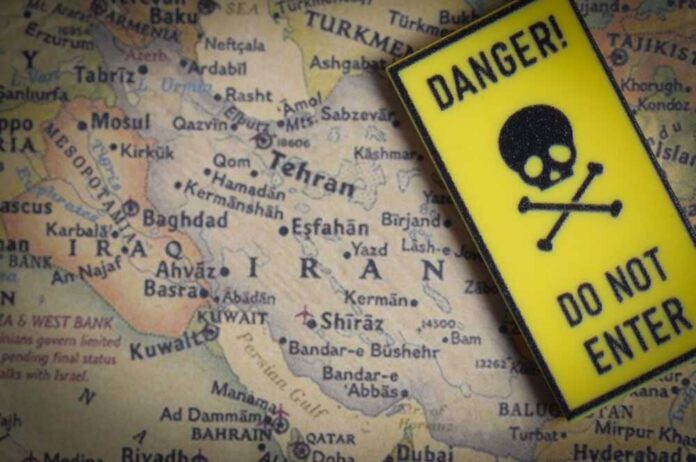
Iran’s Islamic Revolutionary Guard Corps has officially declared American universities across the Middle East as “legitimate targets,” marking a dangerous shift from military installations to civilian educational institutions housing thousands of American students and faculty.
Story Snapshot
- IRGC threatens U.S. and Israeli-affiliated universities throughout the Middle East region following strikes on Iranian educational institutions
- American universities in Iraq, Lebanon, and the Gulf states are implementing emergency security measures and transitioning to remote learning
- U.S. Embassy warns American citizens to evacuate immediately from threatened areas as conflict escalates beyond traditional military targets
- Hundreds of thousands of students at American-style universities are now at risk as Iran broadens the scope of its conflict to civilian infrastructure
IRGC Issues Formal Warning Against Educational Institutions
The Islamic Revolutionary Guard Corps issued a statement titled “Warning to the Criminal Rulers of the US”, designating all American and Israeli-affiliated universities in the Middle East as military targets.
The IRGC ordered employees, professors, students, and area residents to maintain at least one kilometer distance from these institutions.
The threat followed overnight U.S.-Israeli strikes that damaged Isfahan University of Technology and Tehran University of Science and Technology, part of broader military operations that Iran claims have struck more than thirty Iranian universities since February 28.
Universities Scramble to Protect Students and Staff
American University of Beirut immediately transitioned to remote learning for multiple days following the Iranian threats, while other institutions across the region implemented stricter security protocols.
The U.S. Embassy in Iraq issued urgent warnings specifically naming American universities in Baghdad, Sulaymaniyah, and Dohuk, advising all U.S. citizens to depart Iraq immediately.
These emergency measures affect hundreds of thousands of students enrolled at American-style universities throughout Qatar, the United Arab Emirates, Lebanon, Egypt, and Iraq.
Universities that had already shifted to hybrid learning models since the conflict began on February 28 now face intensified security challenges and operational disruptions.
Iran threatens to bomb US and Israeli universities in Middle East https://t.co/VGHfNPi4Zr
— The Denver Gazette (@DenverGazette) March 30, 2026
Escalation Threatens Civilian Infrastructure and American Presence
The Iranian threats represent a fundamental shift in conflict targeting that moves beyond traditional military installations to civilian educational centers.
Ciruce Movahedi-Lankarani, assistant professor of Middle East Studies at USC, confirmed the significance: “It definitely shows that the conflict is expanding quite widely. We’re clearly seeing that institutions or sites that are primarily civilian are now being treated as legitimate targets.”
This escalation undermines the traditional distinction between military and civilian targets that has historically provided some protection for educational institutions.
The Trump administration now faces difficult decisions about protecting American citizens abroad while managing broader military objectives against Iranian aggression.
Iranian Demands and Regional Security Crisis
Iran’s IRGC set a twelve-hour deadline demanding U.S. condemnation of strikes on Iranian universities by 12:00 pm Iran Standard Time on March 30, threatening continued targeting of American institutions without compliance.
Tehran justifies these threats as retaliation for what it calls unlawful attacks on civilian educational facilities, though Western officials have long accused Iranian universities of supporting nuclear and military programs.
The conflict that began on February 28 initially focused on military bases, airports, and energy infrastructure but has now expanded to include academic institutions that represent American cultural and strategic presence throughout the region.
This dangerous broadening of acceptable targets threatens not only immediate safety but long-term American influence and educational partnerships across the Middle East.
Long-Term Implications for American Education Abroad
The threats create unprecedented challenges for American higher education’s international footprint, with institutions facing potential permanent enrollment declines and faculty exodus if security concerns persist.
Yusuf Sidani, Dean of American University of Beirut’s Olayan School of Business, described the reality on the ground: “We hear the bombing. Many of our faculty and staff come from areas affected by it.”
Beyond immediate safety concerns, these threats undermine academic freedom, research collaboration, and America’s soft power projection through educational institutions.
The situation demonstrates Iran’s willingness to weaponize civilian infrastructure in conflicts, potentially establishing dangerous precedents that could normalize targeting educational facilities in future geopolitical confrontations.
American families now face agonizing decisions about their children’s safety abroad while the Trump administration works to counter Iranian aggression without abandoning strategic regional commitments.
Sources:
Iran Warns US-Linked Universities in Mideast Are Targets
IRGC threatens strikes on US universities in Middle East
Iran expands threats to American universities in the Middle East
Iran Warns U.S.-Linked Universities In The Middle East Could Be Targets As Conflict Widens
Iran targets US universities in Middle East