

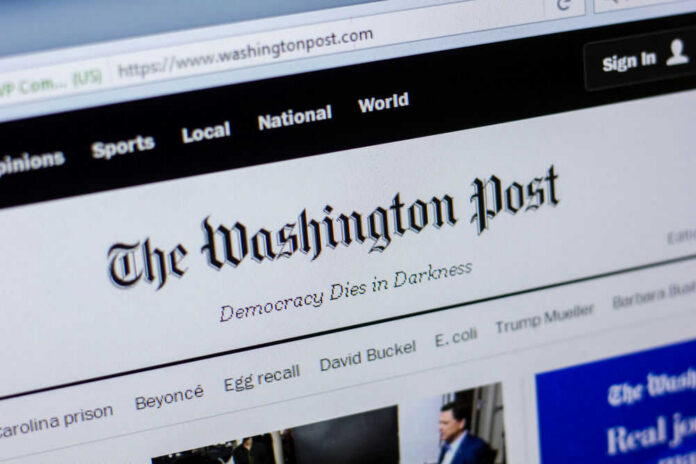
The Washington Post just slashed its local and accountability reporting, which it once used to claim the moral high ground.
Story Snapshot
- Layoffs hit The Washington Post on Feb. 4, 2026, as leadership described a newsroom-wide “strategic reset” amid steep losses.
- Core coverage areas were gutted or closed outright, including sports, books, and the paper’s flagship Post Reports podcast.
- Metro reporting was sharply reduced, with the desk reportedly cut from more than 40 staff to around 12.
- The Post’s ownership and leadership face public pushback from staff, and the union as severance talks and restructuring continue.
What changed on Feb. 4—and what got cut
The Washington Post executed widespread layoffs on February 4, 2026, restructuring major parts of its newsroom and shrinking multiple coverage areas that long helped define the paper’s reach.
Reporting indicates the sports desk was shuttered, the Books section was closed, and the Post Reports podcast was suspended. The international desk was reduced, and the metro desk was dramatically downsized as the organization tries to refocus amid financial strain.
The Washington Post told employees today that it was beginning a widespread round of layoffs that are expected to decimate the organization’s sports, local news and international coverage.
More: https://t.co/rIuz9IRNRB
via @nytimes— Star-Advertiser (@StarAdvertiser) February 4, 2026
Executive Editor Matt Murray framed the changes during a newsroom Zoom call as overdue in light of “difficult realities,” while also indicating the cuts were not a judgment on the quality of staff work. A Post spokesperson described the layoffs as “difficult but decisive actions” intended to strengthen the outlet’s footing and sharpen its focus on distinctive journalism. The reporting available does not confirm exact workforce or subscriber totals, and the Post has declined to provide some numbers.
Financial losses, subscription turbulence, and the Bezos factor
The reporting points to an ugly financial backdrop: estimates of roughly $100 million in losses in 2024, and a figure of $177 million in losses over two years discussed internally. Those losses coincide with a brutal industry environment—digital audiences splintering, advertising dollars weakening, and AI-era competition changing how people discover and consume news.
Unlike a prior round of cuts about a year earlier that reportedly spared the newsroom, this time the reductions reached across newsroom functions.
Owner Jeff Bezos, who bought the paper in 2013, is described as directing the cuts, underscoring how vulnerable even iconic outlets become when they rely on one private decision-maker with ultimate authority.
Under Bezos, the Post expanded aggressively—at one point growing its newsroom by about 85% and reaching more than 3 million paying subscribers. But the current contraction suggests those expansion-era assumptions no longer hold, especially after internal turmoil and strategic misfires described across multiple reports.
Metro and foreign coverage get thinner—public consequences follow
The steepest practical impact may be the narrowing of reporting where ordinary Americans feel it: local and regional coverage. One report puts the metro desk reduction from more than 40 staff to roughly 12, a scale that changes what can realistically be covered in Washington, D.C., and surrounding communities.
Metro reporting is where readers most often find straightforward public-safety reporting, city governance scrutiny, courts, schools, and neighborhood-level accountability that doesn’t fit ideological narratives.
International coverage also appears to be shrinking, and staff have publicly warned what that means in concrete terms. When foreign bureaus or specialized teams are reduced, the public loses direct, on-the-ground verification and is left with thinner rewrites, wire dependency, or content optimized for clicks.
For a conservative audience that values accountability and distrusts narrative-driven gatekeeping, this raises a basic question: who is left to check powerful institutions—public and private—when legacy newsrooms hollow themselves out?
Union backlash, leadership strain, and what’s still uncertain
The Washington Post Guild criticized the layoffs as a move that hollows out credibility, reach, and the paper’s future, and it planned a rally the day after the cuts were announced.
Reports also describe anxiety inside the newsroom as severance negotiations continue and employees weigh whether speaking publicly could affect their outcomes. That tension highlights a broader reality: when a newsroom is consumed by internal survival, the public often gets less watchdog journalism and more institutional self-preservation.
Multiple accounts describe the last 18 months as tumultuous, including leadership controversies and shifting strategic priorities. Former leaders and prominent former staff have criticized decision-making at the top, while current management argues a reset is necessary for an audience that has moved on from old media habits.
The available reporting does not settle whether the cuts will stabilize the business or accelerate decline, but it clearly documents a dramatic reduction in capacity and ambition at a paper that once promised far more.
Sources:
https://www.politico.com/news/2026/02/04/washington-post-layoffs-jeff-bezos-00764227
https://www.opb.org/article/2026/02/04/bezos-orders-layoffs-washington-post/