

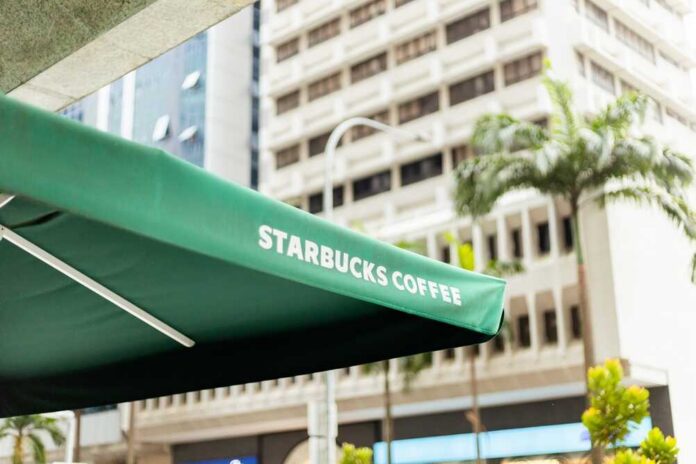
Starbucks just told hundreds of white-collar workers they are expendable while telling Wall Street the pain is all in the name of “durable, profitable growth.”
Story Snapshot
- Starbucks is cutting about 300 corporate support jobs and shutting several regional offices, the third white-collar cull in two years.[1][2]
- Management calls it a key step in the “Back to Starbucks” turnaround strategy to cut complexity and costs while preserving store staffing.[2]
- The company will spend roughly $120 million on severance and write down $280 million in real estate tied to support facilities.[2]
- Critics see a broader pattern of ongoing restructuring that signals deeper business strain, not just tidy belt-tightening.[1][3]
Why Starbucks Is Swinging The Axe Above The Coffee Bar
Starbucks is not touching the baristas who hand you lattes; instead, the company is pruning the people in office chairs behind them. The coffee giant plans to eliminate about 300 United States corporate support roles and close regional offices in Atlanta, Chicago, Dallas, and Burbank, moves it says will cut overhead and simplify how the company is run.[1][2] Executives wrap this in the language of “Back to Starbucks,” a turnaround strategy they claim will restore “durable, profitable growth.”[2]
Starbucks to lay off 300 U.S. corporate workers and close regional offices https://t.co/7sOYxAeaub
— The Washington Times (@WashTimes) May 17, 2026
Management says leaders combed through their departments to “sharpen focus, prioritize work, reduce complexity, and lower costs,” and concluded these jobs were no longer necessary.[2] The company insists no coffeehouse positions are part of this round and that the cuts target back-office duplication rather than front-line service.[1][2] On its face, this fits a familiar corporate pattern: when margins get tight, headquarters staff and regional support offices take the first hit long before the cash registers close.
The Real Estate Quietly Tells The Rest Of The Story
Payroll is only half of what Starbucks is trimming. The company expects to pay about $120 million in severance for the terminated employees and simultaneously reduce the book value of some real estate by roughly $280 million.[2]
Those write-downs focus on reserve and roastery locations and non-retail support facilities, precisely the kind of assets companies rationalize when they admit their empire expanded faster than their earnings.[2] Starbucks also plans to consolidate regional support office space and renegotiate leases to shrink its footprint.[2]
From a common-sense lens, cutting empty space and bloated bureaucracy is better than closing productive stores. Investors typically reward firms that stop throwing good money after bad on underused real estate. Still, the company has not released detailed numbers that prove these specific closures, in these specific cities, deliver the best bang for the buck. Without the full regulatory filing and supporting schedules, the public simply has management’s assurance that this math works out in shareholders’ favor.[1][2]
A Third Corporate Layoff Round Raises Hard Questions
This is not Starbucks’ first swing at its corporate ranks under Chief Executive Officer Brian Niccol. Restaurant industry reporting notes this marks the third round of corporate job cuts during his tenure, following about 1,100 eliminated roles in February 2025 and another 900 in late September that year.[1] Other coverage highlights additional technology-related layoffs in Seattle in the same general period, underscoring that the current 300-job headline sits atop a broader web of reductions.
Repeated cuts of this kind can signal one of two realities. Either leadership is executing a deliberate, staged restructuring to avoid chaos, or it is chasing the problem in increments because the first rounds did not fix the underlying issues. The present record leans heavily on Starbucks’ own talking points and lacks independent financial analysis to prove the cuts are calibrated rather than reactive.[1][2][3] That evidentiary gap is exactly where public skepticism and employee anxiety tend to grow.
Store Experience, Investor Pressure, And The Political Optics
Starbucks links its restructuring to improving store-level experience, promising more barista staffing and investments in operations while it trims the support layer.[1][2] That trade—protect the people making the product, thin out the planners and PowerPoint makers—aligns with basic business logic and resonates with many who value real work over corporate padding. Yet media framing has focused on “mass downsizing” and “job cuts,” making the whole effort look like one more chapter in America’s white-collar squeeze.[3]
Breaking News
Starbucks axes office staff in latest brutal jobs cull under turnaround CEOStarbucks is laying off another 300 US corporate employees and shutting some regional support offices in the latest round of cuts under CEO Brian Niccol.
The coffee giant said the job… pic.twitter.com/Xlydrwgjf3
— News News News (@NewsNew97351204) May 15, 2026
All this unfolds against investor impatience, store closures, and a billion-dollar restructuring narrative that goes beyond one week’s announcements.[2]
Moving support capacity away from high-cost blue cities toward a growing hub in places like Nashville, where Starbucks plans a facility that could employ up to 2,000 people over five years, lines up with a broader migration of corporate jobs toward business-friendlier regions.[1] Whether you see that as smart discipline or corporate musical chairs depends on whether future results actually justify today’s pink slips.
Sources:
[1] Web – Starbucks to cut 300 jobs, close 4 support centers | Restaurant Dive
[2] Web – Starbucks to cut 300 US jobs, close some regional support offices
[3] Web – Starbucks cuts 300 corporate jobs as mass downsizing becomes …