
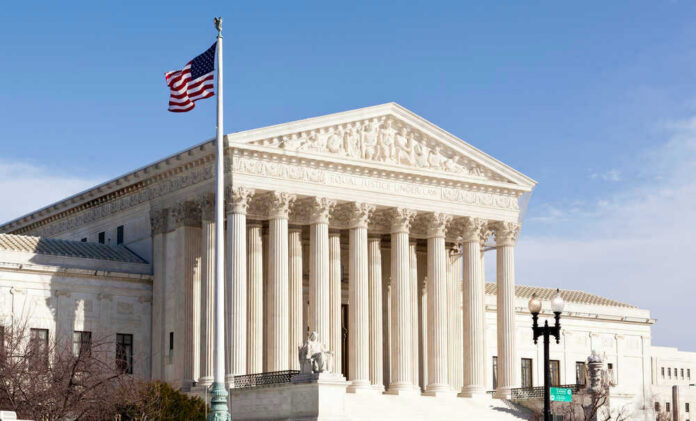
The Supreme Court just told Washington it cannot treat millions of peaceful marijuana users like violent criminals and strip their gun rights by default.
Story Snapshot
- Unanimous Supreme Court ruling protects Second Amendment rights for casual marijuana users [15]
- Federal gun ban on “unlawful drug users” survives, but now applies only when there is real dangerousness [17]
- Justice Neil Gorsuch rejects the idea that millions of marijuana users are “categorically dangerous” [17]
- Gun rights and civil liberties groups score a major win; critics warn about substance abuse risks [14]
The Texas marijuana user who took on Washington and won
Ali Danial Hemani is a Texas man who admits he used marijuana several times a week and owned a gun, with no other criminal charges and no claim he ever handled the firearm while high.[7]
Federal prosecutors charged him under a 1968 law that bans gun possession by anyone who is an “unlawful user or addicted to any controlled substance,” including marijuana under federal law.[16] Hemani’s simple argument was blunt: using pot does not make him a violent criminal and should not cancel his Second Amendment rights.[7]
His case rose through the courts at the same time many states legalized marijuana and after the Supreme Court’s Bruen decision forced judges to test gun laws against historical tradition rather than vague “public safety” claims.[16]
Lower courts began to split on whether casual marijuana use justified disarming otherwise sober, non-violent adults.[16] Hemani’s case became the test, backed by gun rights advocates and civil libertarians who saw status-based bans on peaceful users as a bridge too far.[15]
What the Supreme Court actually decided about guns and marijuana
In a 9–0 ruling, the Court held that applying the drug-user ban to Hemani violated the Second Amendment because the government relied only on his marijuana use, not any evidence he was dangerous.[15]
Justice Neil Gorsuch’s opinion said the law’s core logic “fails under every measure” when it treats all marijuana users as uniquely risky around firearms.[2] He stressed that millions of Americans now use marijuana and the federal government itself helped fuel that trend through policy choices.[2]
The justices drew a sharp line: occasional or regular marijuana use, by itself, is not enough to strip gun rights.[9] The Court compared marijuana to alcohol, noting that while guns and intoxicants can be a bad mix, past laws focused on disarming “habitual drunkards” while intoxicated, not sober people who drink at home.[15]
Under this ruling, prosecutors now must show a concrete link between drug use and dangerous behavior before they can send someone like Hemani to prison for owning a gun.[17]
How much of the federal ban survived and where the limits still are
The Court did not erase the federal statute; it narrowed how it can be used.[17] Justice Gorsuch made clear the ruling is “in many respects, a narrow one,” and that government may still bar gun possession by addicts, people currently intoxicated, or users of extremely dangerous drugs who always pose grave risks.[17]
The decision blocks the old practice of treating any illegal drug use, even occasional marijuana, as enough to justify up to fifteen years in prison for having a firearm.[2]
🚨 BOMBSHELL SCOTUS DECISION JUST DROPPED! 🚨
In a UNANIMOUS ruling, the Supreme Court just STRIPPED the federal government’s power to disarm millions of Americans for marijuana use!
The 1968 law that banned gun ownership for “unlawful users” of controlled substances? Ruled… pic.twitter.com/xQ1MgkQNbp— CONSTITUTIONAL PATRIOT🇺🇸 (@ConstitustionX) June 19, 2026
Federal law still labels marijuana illegal, and rules for licensed gun dealers and federal forms have not instantly changed.[16] The Bureau of Alcohol, Tobacco, Firearms, and Explosives still warns buyers on Form 4473 that marijuana use is unlawful under federal law, even where states legalize it.[12]
What has changed is the constitutional backstop: a casual marijuana user who is otherwise law-abiding now has strong Supreme Court support if prosecutors try to treat his status alone as proof of danger.[15]
Political fault lines and what common sense conservatives see here
This ruling scrambled usual partisan lines. Gun violence prevention groups backed the Trump administration’s defense of the drug-user ban, while the National Rifle Association and American Civil Liberties Union supported Hemani’s challenge.[14]
Media coverage framed the decision as a setback for the Trump-era Justice Department that had championed the 1968 law even as the government moved to soften marijuana’s official risk rating.[7] That tension exposed a deeper problem: preaching limited government while defending broad, status-based bans.
From a common-sense conservative view, the Court’s reasoning tracks core principles: punish dangerous acts, not harmless habits; demand evidence, not stereotypes; and keep the federal government from using vague labels to peel away fundamental rights.[15] Critics warn the ruling may complicate efforts to keep guns away from people with serious substance abuse problems.[13]
But the justices did not bless guns plus hard drugs; they insisted Washington prove actual danger and stop treating millions of peaceful marijuana users like an excuse to weaken the Second Amendment for everyone else.[17]
Sources:
[2] Web – This morning the Supreme Court ruled in favor of our client …
[7] Web – Gun rights 2nd amendment win from a Texas case
[9] Web – Today, SCOTUS hears U.S. v. Hemani—a case that could …
[12] YouTube – Supreme Court allows some marijuana users to own guns, limiting …
[13] Web – What are the legalities of owning firearms in states where marijuana …
[14] Web – Supreme Court to hear arguments on legality of gun bans for …
[15] Web – The Supreme Court ruled Thursday against a broad federal ban on …
[16] Web – In a unanimous decision, the Supreme Court ruled that a … – Facebook
[17] Web – Gun Rights And Marijuana Act – Congressman Brian Mast – House.gov