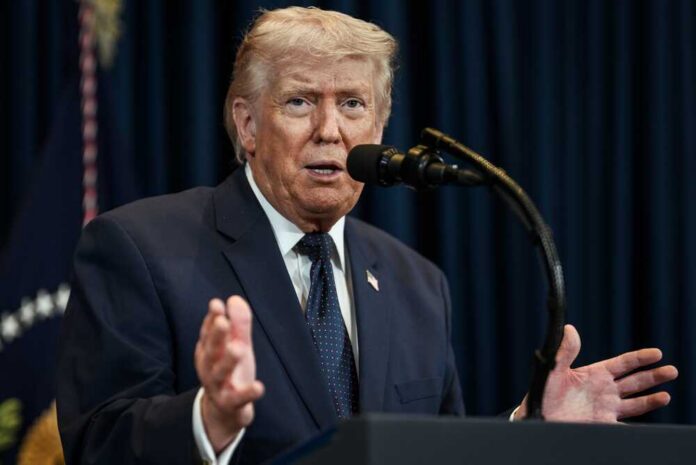
A man paid to feed words into President Donald Trump’s teleprompter was quietly making six figures betting on those same words online.
Story Snapshot
- Gabriel Perez, Trump’s longtime teleprompter operator, allegedly won over $90,000–$100,000 betting on Trump speeches on Kalshi.
- Kalshi’s surveillance system flagged his trades as suspicious and reported him to the Commodity Futures Trading Commission (CFTC).
- Perez is on unpaid leave, cooperating with regulators, and is in civil settlement talks, not facing criminal charges.
- The case exposes a growing problem: government insiders using new “prediction markets” to cash in on nonpublic information.
A teleprompter operator who turned inside words into outside money
Gabriel “Gabe” Perez did a simple job on the surface. He loaded, adjusted, and ran the teleprompter that guided President Donald Trump’s speeches. He had worked with Trump since 2016 and was a familiar, low-profile hand behind the scenes.
But while he prepared Trump’s words for the cameras, investigators say he also used those words in a very different way: as fuel for high-odds bets on Kalshi, a popular prediction market.
Kalshi lets users bet on very specific events, including “mention markets” that pay out if a politician says certain words or phrases during a speech. According to reporting based on regulator sources, Perez wagered on more than a dozen Trump speeches over roughly three months, including major addresses like the State of the Union.
With advance access to drafts and planned talking points, he could know which phrases were likely to appear before the public did, giving him a huge edge on these narrow markets.
How Kalshi caught the trades and froze the profits
The story did not break because Perez bragged or because reporters got lucky. It broke because Kalshi’s own surveillance systems flagged his trading as suspicious. The company says it detected unusual success in mention markets tied to Trump speeches and then identified the trader as a federal government employee.
After that, Kalshi froze the account before more than $90,000 in profits could be withdrawn, and referred the case to the Commodity Futures Trading Commission, the federal agency that oversees prediction markets.
President Donald Trump's longtime teleprompter operator, Gabriel Perez, has drawn ire from the White House after reports he'd profited from Kalshi bets linked to content in Trump's speeches. https://t.co/kYWkQSjsD7
— Business Insider (@BusinessInsider) July 16, 2026
Kalshi’s head of enforcement publicly said their team “promptly flagged and referred these trades to the CFTC after an exchange investigation,” and that the platform has been assisting regulators and sharing evidence. That is important for two reasons.
First, it undercuts the idea that these platforms are the Wild West with no guardrails. Second, it means there is likely a detailed data trail showing when Perez placed each bet, how accurate they were, and how closely they lined up with his access to Trump’s prepared remarks.
Regulators, the White House, and what “insider trading” means here
The Commodity Futures Trading Commission has opened a civil investigation focused on whether Perez used nonpublic information from his job to profit on Kalshi. Reports say he is in settlement talks that would likely force him to give back his earnings and accept limits on future trading, rather than fight the case through a full hearing.
Federal prosecutors in Manhattan reviewed the referral but declined to open a criminal case, suggesting they either saw weak criminal evidence or judged it not worth pursuing.
The White House responded by placing Perez on unpaid administrative leave and later signaling he would not return to his role. Trump’s press secretary called the situation “deeply unfortunate” and “a disgrace,” language that clearly distances the president from the conduct and frames it as personal wrongdoing, not a system failure.
Many argue public employees should not secretly cash in on privileged information, especially when their job is literally to handle a president’s words before anyone else hears them.
A bigger pattern: prediction markets and government insiders
Perez’s case is not an isolated glitch. It fits into a fast-emerging pattern of insiders using prediction markets to quietly monetize information that taxpayers expect them to handle with trust.
This year alone, federal officials have flagged multiple such schemes, including a United States Army soldier indicted for using classified military data to make over $400,000 on another platform, Polymarket.
Regulators and law firms now openly warn that general fraud laws and Commodity Futures Trading Commission rules apply to these markets just as they do to stock trading.
The White House itself had already warned staff not to use confidential information about war and policy to trade on prediction sites, after seeing suspicious patterns around Iran-related events.
Democrats in Congress are pressing for broad training so every federal worker understands that betting on internal polling, advance drafts, or classified operations crosses the line into insider trading when it involves real-money markets.
New York’s governor has even banned state employees from using nonpublic information on prediction platforms, a move that tries to nip this behavior before it spreads further.
What this says about trust, ethics, and the political class
There is no final legal ruling yet that Perez committed insider trading, and the lack of criminal charges matters. Innocent until proven guilty still counts, even in the age of viral outrage. But the known facts should bother anyone who cares about basic fairness.
A White House employee, with advance access to a president’s speeches, repeatedly bet on the content of those speeches and made tens of thousands of dollars until the market itself cut him off.
For many voters, this feeds a familiar feeling: that too many people around power treat politics like a hustle, not a duty. Instead of serving the country, they look for angles. Prediction markets are not evil by themselves; in theory, they can surface useful information and keep elites honest.
But when the person typing a president’s lines is also quietly wagering on them, the line between public service and private gain has clearly been crossed. From a common-sense view, the fix is simple and firm: if you work for the government, you do not get to gamble on your own insider knowledge, period.
Sources:
cbsnews.com, reuters.com, gate.com, facebook.com, instagram.com, news.bitcoin.com, wired.com, pillsburylaw.com, nytimes.com, cnn.com, usnews.com, kslaw.com