

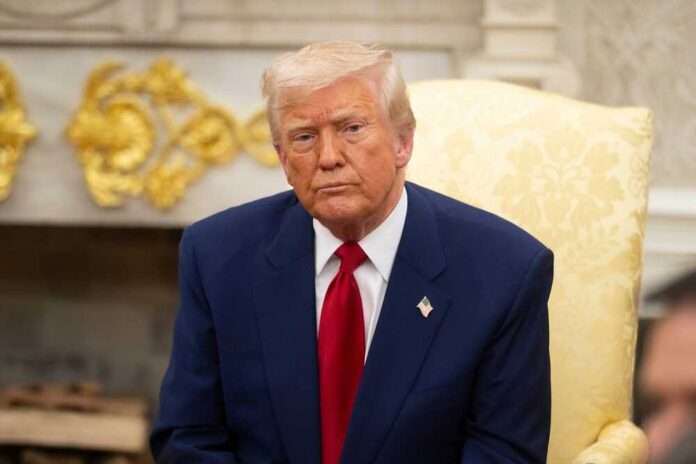
President Trump’s blunt demand for Iran’s “unconditional surrender” is forcing Washington to choose between a clean, decisive end and the kind of early exit that has burned Americans before.
Quick Take
- Trump publicly raised the stakes by tying any deal with Iran to “unconditional surrender” as U.S. and Israeli strikes intensified.
- Operation Epic Fury has been framed by the president as nearing completion, even as Iran continues launching drones and missiles at regional targets.
- Reports describe a major shift from earlier talk of Iranian self-determination to U.S. involvement in post-regime leadership selection.
- U.S. officials also faced new homeland-security anxiety after an FBI warning about Iranian “aspirational” drone-strike interest on the West Coast.
Trump’s Surrender Line Clarifies the End-State
President Donald Trump’s message has been unusually direct: any U.S. deal with Iran requires “unconditional surrender,” delivered as U.S.-Israeli bombardment hit targets across the country, including in the capital.
Reporting described the air campaign as among the heaviest of the conflict, now roughly a week old in the public timeline. Iran, meanwhile, signaled openness to mediation through unnamed countries while continuing retaliatory strikes.
For Americans who watched prior administrations drift into open-ended conflicts while also projecting weakness overseas, the clarity matters. A declared end-state can reduce mission creep, but it also creates an all-or-nothing standard that is difficult to unwind.
The available reporting does not document the specific “finish the job” phrasing in a single transcript, yet it consistently portrays Trump’s position as staying engaged until the objective is complete.
What Operation Epic Fury Looks Like on the Ground
Accounts of Operation Epic Fury describe coordinated U.S.-Israeli airstrikes paired with Iranian drone and missile attacks against Israeli sites and at least one U.S. base in Kuwait.
Israel has also carried out strikes beyond Iran, including in Lebanon, reflecting a wider regional escalation rather than a tidy, isolated campaign. Separately, reporting flagged that Russia has provided intelligence support to Iran, complicating assumptions about deterrence.
NOW – Trump on Iran: "We don't want to leave early, do we—huh?! We gotta finish the job, right?!" pic.twitter.com/9PPJ1DaSTm
— Disclose.tv (@disclosetv) March 11, 2026
Those battlefield details help explain why Trump and his team face competing pressures at home. Some voices urged a victory declaration and withdrawal once core military targets are neutralized, while others argue that leaving early invites Iran’s leadership to regroup.
The research summary also notes merchant mariners facing elevated danger around key shipping lanes, raising the risk of broader economic disruption if the conflict spills further into maritime chokepoints.
The “Venezuela Model” Question: Regime Change vs. Self-Determination
One of the most consequential developments in the reporting is the stated shift from early promises of Iranian self-determination to talk of U.S. involvement in selecting or vetting post-regime leadership, compared to a “Venezuela model.”
Analysts cited in the research warn that externally imposed leadership could generate resentment among Iranians who want a full break from theocracy rather than a reshuffled continuity.
From a conservative, constitutional perspective, that distinction matters because Americans have paid dearly when Washington blurs the line between decisive military action and nation-building. The research does not provide detailed evidence on what a post-conflict governance plan would look like, which limits firm conclusions.
Still, the documented pivot highlights the strategic tradeoff: installing a favorable successor may reduce immediate security threats, but it can also invite long-term instability.
Domestic Security: FBI Warning Adds a New Layer of Risk
By March 11, reporting referenced an FBI warning that Iran has “aspirational” interest in drone strikes on the U.S. West Coast. That is not the same as an imminent, confirmed plot, but it reinforces why Americans demand competent border control, serious counterterrorism, and clear-eyed threat assessments.
When hostile states feel cornered, asymmetric retaliation becomes more likely, particularly against soft targets or critical infrastructure.
The same window of coverage also described competing signals from Trump’s orbit: advisors pushing to declare victory and withdraw, while the president emphasized not leaving early. Those tensions are familiar to voters who remember years of global commitments paired with weak follow-through.
The hard part, based on the limited public detail available, is that “victory” can be defined militarily, politically, or ideologically—and each definition carries different costs.
Where This Heads Next: Finish, Freeze, or Negotiate
The reporting lays out three practical paths without guaranteeing any of them. First, the U.S. and Israel can continue strikes until Iran’s leadership capitulates as demanded, betting that decisive pressure prevents a future resurgence.
Second, Washington can “freeze” the campaign after a victory declaration, accepting residual risk to avoid an open-ended footprint. Third, mediated talks could produce a deal, though Trump’s surrender demand narrows the diplomatic lane.
Trump says US must 'finish the job' in 'virtually destroyed' Iran: 'Don't want to leave early' https://t.co/8P7AHz4cKv pic.twitter.com/Vg0IlLkztK
— New York Post (@nypost) March 11, 2026
For conservatives focused on limited government and national sovereignty, the central question is whether the operation can end with clear objectives met and minimal long-term entanglement.
The research confirms heavy strikes, Iranian retaliation, and a shifting post-war posture, but it does not provide enough verified detail to judge the durability of any proposed settlement. What is clear is that the administration is signaling it prefers an ending, not a pause.
Sources:
Trump to Fox News (March 10): Outlines completion criteria for operation.