

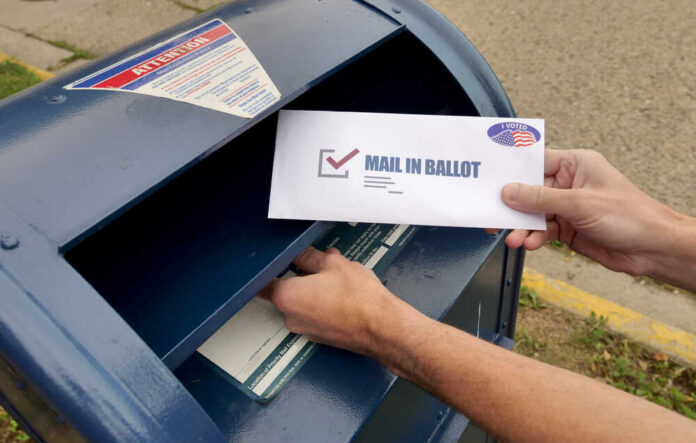
A fight over who controls your mail ballot has rocketed from low-level courtrooms straight to the Supreme Court, with President Trump betting that tighter federal checks on citizenship and postal voting will arrive in time to shape this year’s midterms.
Story Snapshot
- President Trump signed an order building federal citizenship lists and tying them to mail ballots.
- The order forces states and the Postal Service into a new election integrity system before midterms.
- Lower courts split, and now the administration is asking the Supreme Court to unlock the plan.
- Supporters call it common-sense security; critics warn it could block eligible voters from casting ballots.
Trump’s order rewires mail voting around federal citizenship checks
President Trump’s March 31 executive order, titled “Ensuring Citizenship Verification and Integrity in Federal Elections,” does not nibble at the edges of mail voting; it tries to rebuild the system around federal data.
The order tells the Department of Homeland Security and the Social Security Administration to compile state-by-state lists of voting-age United States citizens, drawn from federal databases. Those lists become the core record for federal elections, meant to help states reconcile their voter rolls and confirm who is allowed to vote by mail.
The same order directs the United States Postal Service to treat those federal lists as a gatekeeper. Postal workers would deliver mail ballots only to people who appear on the approved list of absentee voters, or on a state “citizenship list” that DHS and the Social Security Administration help create.
In plain terms, the White House wants the federal government to decide who is in the pool for mail voting, and then wants the Postal Service to limit ballot delivery to that pool.
The Trump administration on Monday asked the Supreme Court to allow it to fully implement an executive order signed by President Donald Trump that seeks to impose additional restrictions on mail-in voting.https://t.co/ZKlX2ZorM5
— SCOTUSblog (@SCOTUSblog) July 27, 2026
How the order works and why the timing matters
The order reaches beyond ballot delivery rules. It requires states to share their voter files so federal agencies can flag noncitizens and build a new database of eligible voters. It tells the Postal Service to condition mail-ballot processing on states sending in lists of eligible mail voters well before an election, at least sixty days out in many states, so that federal checks can happen in advance.
It also orders states to preserve election records for five years, a move the administration sells as a way to allow better audits and fraud investigations.
All of this lands in the run-up to midterm elections, with tight races and narrow congressional margins. That timing is not an accident; the administration describes the order as an election-integrity measure meant to be in place for this November’s contests.
To get there, agencies are rushing to stand up new data systems and procedures. Voting rights groups, state coalitions, and local election officials argue those systems are untested and could misfire when millions of ballots are on the line.
Courts, critics, and the clash over who runs elections
Legal fights started almost as soon as the ink dried. A federal judge first refused to block parts of the order, accepting the administration’s argument that the case was premature because the agencies had not fully implemented the plan yet.
That early win did not last. Other courts later stepped in, and key parts of the Postal Service limits and federal voter-screening system are now paused in twenty-three states and the District of Columbia while lawsuits proceed.
State officials and voting rights groups say the Constitution gives states, not the president, the primary power to run elections, including mail voting rules. They argue that turning the Postal Service into an arbiter of who may cast a ballot by mail crosses a bright line. The Brennan Center describes the order as an “illegal and dangerous attempt” to override state mail-in voting laws.
The American Civil Liberties Union calls it part of “unconstitutional attacks” on elections. These groups warn that federal databases were never built to decide ballot access and contain errors that could wrongly block eligible citizens.
The Supreme Court battle and what Americans see at stake
After those lower-court setbacks, the Trump administration went to the Supreme Court and asked the justices to clear the way for full implementation of the executive order before the midterms. This comes just weeks after the Court rejected a separate Republican push to stop Mississippi from counting mail ballots that arrive within five days after Election Day, as long as they are postmarked on time.
In that case, the Court held that federal election-day statutes do not force states to throw out properly postmarked ballots that arrive shortly after Election Day.
The new dispute is sharper. It asks whether an executive order can reshape mail voting nationwide by using federal citizenship data and postal controls, despite state objections and without clear direction from Congress. Many see the order as a long-overdue effort to ensure only citizens vote and to bring some order to a patchwork of mail-ballot rules.
They argue that asking states to share voter files and having the Postal Service check names against a federal list is common sense, not a threat to democracy, especially when faith in elections is shaky.
Unanswered questions that will decide who can vote by mail
Supporters of the order say the federal lists will help clean up voter rolls and catch noncitizens before ballots go out. Critics point out the record so far does not show how accurate those lists really are or how many eligible voters might be left off.
Department of Justice lawyers have already admitted in court that the planned citizenship lists will be “underinclusive and incomplete,” which raises the risk that real citizens could be denied mail ballots.
Those practical questions matter more than slogans. Americans over forty know that bureaucracy can be slow and data can be wrong. If the Supreme Court lets the order go forward, states and the Postal Service will have to build and test this new system in months, not years.
The justices are not only weighing one executive order; they are deciding how far a president can go in using federal databases and the mail system to police voting, and whether that power lines up with the Constitution’s balance between Washington and the states.
Sources:
abcnews.com, cnn.com, aclum.org, scotusblog.com, reuters.com, naco.org, votingaccessforall.org, youtube.com, issueone.org, archive.org, whitehouse.gov