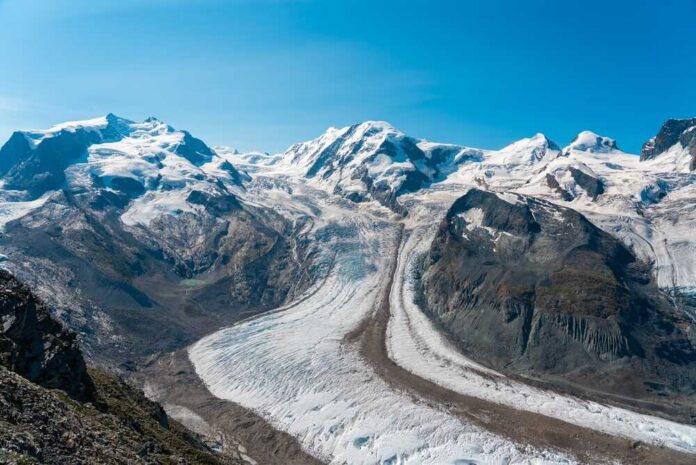
Two brutal summers erased about one-tenth of Switzerland’s glacier ice, a shift scientists say marks a new baseline for the Alps.
Story Snapshot
- Swiss monitoring shows a 10% loss in glacier volume across 2022 and 2023.
- Scientists measured annual mass balance on about 20 glaciers and tracked 95 glacier fronts.
- Record heat and low winter snow drove the second-worst melt on record in 2023.
- The results fit a century-long Swiss record, not a one-off blip.
What the data says, not the headlines
Glacier Monitoring Switzerland reported rapid ice loss across the country’s glaciers in 2023, following record losses in 2022. The group’s mass-balance network weighed the “ledger” of snow gained and ice lost on about 20 benchmark glaciers. The bottom line showed a steep decline across regions. Their release described a two-year volume hit of about 10 percent, with 2023 alone removing around four percent of total ice, the second-largest annual drop since records began.
Length-change surveys of glacier snouts added another lens. Teams measured the advance or retreat of the ice front on 95 glaciers in 2023. The counts showed widespread retreat, confirming what the mass numbers already flagged: ice bodies are shrinking in both thickness and reach. These paired methods are old-school in the best way. They are repeatable, anchored to specific sites, and checked the same way year after year, so a single hot summer does not skew the whole picture.
How a “disastrous year” forms
Heat stacked the deck. Switzerland endured severe warmth in the 2022 and 2023 melt seasons. Snow that should protect the ice surface arrived late, fell thin, or vanished early. Bare, dark ice then absorbed more sun and melted faster. Scientists pinpointed that 2023’s losses trailed only 2022’s record decline. A reliable monitoring shop used calm math, not alarm, to tally the damage: the Alps had their one-two punch, and the ice ledger paid the bill.
Glacier Monitoring Switzerland’s job is not to chase weather stories. It runs a long-term system with consistent tools. Annual mass balances on about 20 glaciers roll into multi-decade time series that let researchers place a bad year in context. That context matters. The Swiss Glacier Bulletin and the Glaciological Report compile the same types of measurements, collected the same way, for more than a century. When this network says a year was disastrous, it is speaking in a language built on long records.
Why this year is different from the last “bad year”
Many readers ask if a harsh melt year is only weather. The records let us separate noise from signal. The new losses sit on top of a long decline line. The point is not that every year will be worse than the last. The point is that the base has shifted lower. After 2022 and 2023, scientists say the ice stock is smaller, thinner, and less able to bounce back with one snowy winter. Restoring 10 percent of national glacier volume would take many cold, wet years in a row, which recent history has not delivered.
Conservative common sense favors measured evidence over hype. Here, the evidence is specific and replicable. The mass-balance program weighs snow and ice. The length surveys map glacier fronts. The Swiss Glacier Inventory outlines every glacier. These are simple, sturdy tools that reduce guesswork. They also anchor local planning. Water managers, hikers, farmers, and hydro operators need numbers they can trust. This network exists to supply them.
What it means for people, not just peaks
Glaciers act like water savings accounts. They release melt in late summer, when streams run low. When the account shrinks, that buffer weakens. Hydropower planners will see more feast-or-famine flow. Trail crews will face unstable slopes where ice once braced rock. Tourism maps will change as familiar tongues of ice pull back. These shifts do not arrive in one day. They creep in, season by season, and then present a bill that communities must pay with money, time, and grit.
Swiss glaciers lost 5.5% of their ice volume in 2026, bringing the total loss to nearly 20% since 2021. Scientists attribute the rapid melting to record summer heatwaves and unusually low winter snowfall pic.twitter.com/6FkZx40BQG
— TSN NEWS (@TSNGlobalNews1) October 2, 2026
What happens next depends on two clocks. The first is the weather clock: next summer’s heat, next winter’s snow. The second is the climate clock: the trend that sets the odds for many summers to come. Switzerland’s edge is its discipline. It measures, it publishes, and it compares each year with the last hundred. That lets citizens judge trade-offs soberly. Stay focused on the ledger, not the noise, and act where the math is strongest: cut risk, build resilience, keep score.
Sources:
bbc.com, cryosphere.scnat.ch, doi.glamos.ch, geo.uzh.ch, euronews.com