
For the first time in half a century, the Senate actually tried to take war away from the president and hand it back to Congress.
Story Snapshot
- The Senate passed a war powers resolution 50–48 to halt Trump’s Iran war[1][10]
- Four Republicans broke ranks, signaling real unease with endless conflict[2][3]
- The measure is symbolic in law but sharp in political message[1][2][4]
- It revives a long fight over who in Washington gets to start – and stop – wars[17][19]
Senate delivers a rare public check on presidential war making
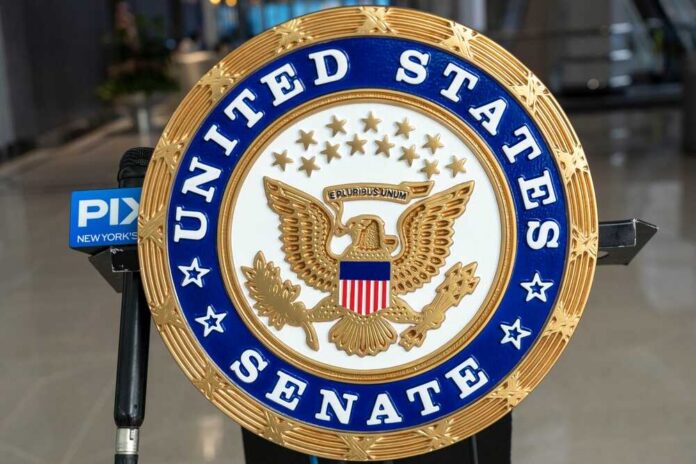
The United States Senate did something it almost never does: it told a sitting president to stop a war he was already fighting. On a 50–48 vote, senators approved a war powers resolution that directs President Donald Trump to remove United States forces from hostilities with Iran that Congress has never authorized[1][10].
The resolution uses the War Powers Resolution of 1973, a law passed after Vietnam to curb “solo” presidential wars, as its legal backbone[10][19]. This was the tenth try in the Senate; this time, it finally passed[1][4].
The vote mattered because both chambers agreed to the same concurrent resolution, House first, then Senate, which has never happened before on Iran. The House approved the measure on June 3 by a narrow 215–208 margin, with a handful of Republicans joining Democrats to say the Iran conflict needed clear permission from Congress[5][18].
By taking up that same House text and passing it, the Senate turned a scattered protest into a unified congressional statement that Trump’s Iran war does not have broad legislative backing[2][10][23].
Bipartisan cracks in the Republican shield around Trump’s Iran policy
The narrow margin hides a bigger story: some Republicans decided the president had gone too far. Senators Susan Collins of Maine, Lisa Murkowski of Alaska, Bill Cassidy of Louisiana, and Rand Paul of Kentucky joined almost all Democrats in voting yes[2][3].
Their votes pushed the resolution over the top and turned past failed attempts into a win. At the same time, Democratic Senator John Fetterman of Pennsylvania voted no, showing that even Trump’s critics worry about tying the commander-in-chief’s hands too tightly in a live conflict[2][3][18].
Senate for first time approves a war powers resolution in a rebuke to Trump over Iran conflict https://t.co/FR7wdMVdfr
— WSFA 12 News (@wsfa12news) June 23, 2026
Republican leaders tried to hold the line. They argued that Trump’s actions in Iran were “limited in scope” and that new restraints would hurt military flexibility in the middle of operations[7][11]. Some said presidents can run military missions as long as Congress keeps the money flowing, and that cutting funds – not passing war powers resolutions – is the only real check[7].
That view fits a long trend where presidents of both parties stretch their claimed power under Article II of the Constitution to launch airstrikes and raids without clear votes from Congress[17][19]. But the four GOP defections show that, for some, Iran crossed a line.
A symbolic resolution with real constitutional and political bite
On paper, this resolution looks weak. It is a concurrent resolution, not a full law. It does not go to the president’s desk. It cannot force him, by itself, to pull troops out of Iran[1][2][4]. That is why many outlets called it “largely symbolic” and “ceremonial.” Yet for voters who care about the Constitution, the symbolism matters.
Congress used the very tool the War Powers Resolution of 1973 created – the power to direct withdrawal from hostilities – to say Trump’s Iran war needs a vote or it needs to end[10][21]. That is a clean, common-sense idea: offensive wars should require the people’s branch to say yes.
The US Senate has passed a 50–48 War Powers Resolution requiring President Donald Trump to seek congressional approval before any further military action against Iran. Four Republican senators joined Democrats in a rare bipartisan rebuke, while Trump condemned the vote. pic.twitter.com/EFwXL4d0dF
— Meridian Point (@PointMerid254) June 24, 2026
The Trump administration shrugged off the vote and doubled down. White House officials describe their Iran moves as necessary to stop Tehran’s nuclear ambitions and to weaken its missile and naval forces, and they have allies on Capitol Hill who praise those strikes as making Americans safer[7].
At the same time, the Pentagon told senators it needs about eighty billion dollars more to pay for the Iran war effort, on top of already high defense spending[5]. That funding request puts Congress in a bind: say no and risk blame if the war goes badly, or say yes and reward a president for bypassing them in the first place.
The larger war powers tug-of-war conservatives cannot ignore
This Iran episode fits a decades-long pattern. Since the War Powers Resolution was passed over Richard Nixon’s veto after Vietnam, presidents from George H.W. Bush to Bill Clinton, Barack Obama, and Donald Trump have pushed military powers outward, often without explicit votes to declare war[17][19][20].
Legal analysts show how the executive branch keeps widening ideas like “self-defense” and “limited strikes” to fit whatever mission it wants[20]. That approach clashes with the simple constitutional rule many conservatives still back: Congress raises and supports the military and declares war; presidents lead the fight after the people’s representatives decide it is necessary[19][21].
For Americans who worry about runaway government, this fight is bigger than Trump or Iran. If war decisions slide into the White House by habit, voters lose their main leverage: the ability to pressure representatives to stop an unpopular conflict before it grows. Public polling has shown major doubts about Trump’s handling of Iran, yet translating that into firm votes in Congress has been hard[7].
This new resolution does not end the war, but it warns future presidents that the Senate and House will sometimes push back. Whether that warning turns into real limits will depend on what Congress does next: demand authorizations, scrutinize funding, and insist that no president wages a war of choice on autopilot.
Sources:
[1] Web – Senate for first time approves a war powers resolution in a rebuke to …
[2] Web – Senate passes Iran War Powers resolution despite Trump’s opposition
[3] Web – Senate adopts House-passed Iran resolution in symbolic rebuke of …
[4] YouTube – Senate passes war powers resolution to curb future US …
[5] Web – US Senate for first time approves Iran war powers resolution, in …
[7] YouTube – U.S. Senate passes war powers resolution in rebuke to Trump over …
[10] Web – Senate passes bipartisan resolution to curb Trump’s war authority on …
[11] Web – Senate Approves Legislation To Limit President’s War Powers …
[17] Web – Findings and Analysis | War Powers Resolution Reporting Project
[18] Web – What’s next for the War Powers Resolution on Iran? PolitiFact explains
[19] Web – War Powers | Brennan Center for Justice
[20] Web – War Powers and the Return of Major Power Conflict
[21] Web – [PDF] Ballotbox Diplomacy: The War Powers Resolution and the Use of …
[23] Web – The Senate adopted a resolution directing President Donald Trump …