

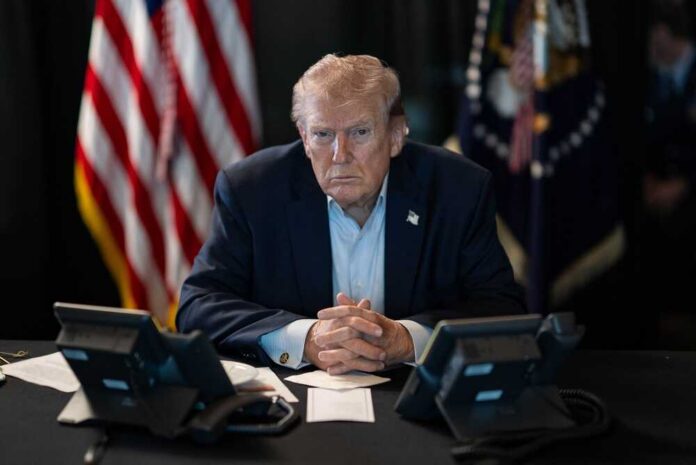
A Republican-controlled state Senate just handed President Trump one of his most embarrassing domestic defeats of 2026, and the man who stopped it was one of his own party members who said his conscience wouldn’t let him cancel an election already in progress.
Story Snapshot
- South Carolina’s Republican-dominated Senate killed a Trump-backed plan to redraw congressional maps mid-cycle, with the vote collapsing even before enough senators could be gathered to pass it.
- Early in-person voting had already begun on the day of the Senate vote, making the timing of the proposed redraw extraordinarily unusual and legally provocative.
- Republican Senator Richard Cash cited conscience and common sense as his reasons for refusing to support a map change while citizens were actively casting ballots.
- The South Carolina House had passed the new map 74-37 on May 20, 2026, meaning the Senate rejection was the decisive and final blow to the effort.
What Was Actually Being Proposed and Why It Mattered
The National Republican Redistricting Trust drafted a new congressional map for South Carolina that would have replaced the current district boundaries ahead of the November 2026 midterm elections. The South Carolina House passed it by a 74-37 vote on May 20, 2026, with nearly the entire Republican caucus in support. The argument from backers was straightforward: no law prohibits redrawing maps between census cycles, and the legislature has the authority to act when it chooses to do so.
BREAKING: The South Carolina Senate on Tuesday rejected President Donald Trump’s push to redraw the state’s congressional district in hopes Republicans could gain an additional seat in the midterm elections. #scnews
>>https://t.co/OHwq8MYDHP pic.twitter.com/eSPNbKPAyE
— WCBD News 2 | Count on 2 (@WCBD) May 26, 2026
That argument is technically accurate. Mid-decade redistricting is not categorically illegal under federal law. Texas Republicans used the same logic in 2003 when they pushed through a mid-decade remap under Tom DeLay that flipped several congressional seats. Courts ultimately allowed it. So the legal foundation for what South Carolina’s House attempted was not invented out of thin air. The problem was not the law. The problem was the timing, and one Republican senator made that point in a way that was impossible to dismiss.
The Senator Who Stopped It With One Sentence
Republican Senator Richard Cash said he could not support the measure because South Carolina citizens were going to the polls that very day. His conscience and common sense, he said, would not allow him to stop an election already underway. That statement deserves more attention than it has received. Cash is not a Democrat. He is not a Trump critic by habit or temperament.
He is a conservative who looked at the specific facts in front of him and concluded that changing the rules of an election while voters are casting ballots crosses a line that no partisan objective justifies crossing.
That kind of institutional restraint is exactly what distinguishes a functioning republic from a system where the party in power rewrites the rules whenever the stakes get high enough. Cash’s position reflects a principle that should be non-negotiable regardless of which party benefits: elections must be conducted under the rules that were in place when voters showed up.
The moment that standard becomes negotiable, every future election becomes suspect. His reasoning was not weakness. It was constitutional common sense applied under pressure.
The Broader Pattern That Makes This More Than a Local Story
Mid-decade redistricting fights are almost never about neutral representation corrections. They happen when a party believes it can gain seats by moving boundaries, and the timing of this particular effort makes that calculus unusually transparent. South Carolina already has a Republican supermajority in its state legislature and holds six of seven congressional seats. The proposed remap was aimed at making the one remaining competitive district safer for Republicans heading into a cycle where national headwinds may favor Democrats.
Failed Redistricting: South Carolina Senate Now Defying Trump on Maps https://t.co/gN1y8f4GOT
— Norman Germond (@ngermondlvrg) May 28, 2026
The fact that the Republican-controlled Senate could not muster the votes even with a supermajority tells you something important. Some Republican senators clearly calculated that the reputational and legal risk of altering district lines while ballots were being cast outweighed whatever marginal seat advantage the new map might deliver.
That is a rational calculation, and it is also a sign that institutional guardrails still function when individual legislators are willing to act on principle rather than party loyalty. South Carolina’s Senate did not do Trump a favor by rejecting his push. It did the state’s voters one.
Sources:
[1] Web – South Carolina Senate rejects Trump’s call to redraw congressional map …
[2] YouTube – Rep. James Clyburn responds as SC Senate rejects …
[3] Web – What to know about redistricting in South Carolina
[4] YouTube – South Carolina Senate rejects congressional map redraw
[5] YouTube – Lawmakers react after South Carolina Senate rejects Trump-backed …
[6] Web – South Carolina Senate rejects President Trump’s call to redraw …
[7] Web – SC Senate kills 2026 redistricting effort amid early voting – The …
[8] Web – 2026 South Carolina House Election Map – 270toWin.com