

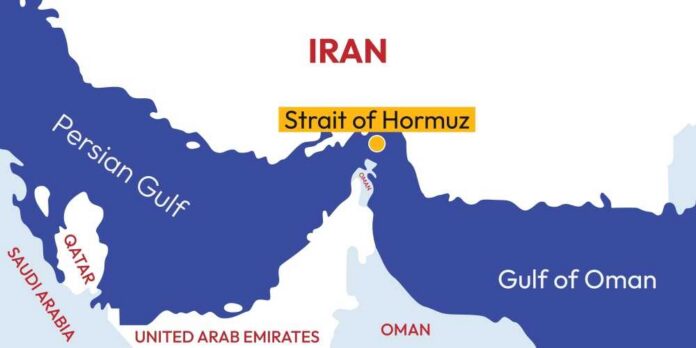
Washington hit Iran again while Tehran insisted nothing vital was struck—and that gap between what each side claims is where this story actually lives.
Story Snapshot
- U.S. forces said they shot down four Iranian one-way attack drones and hit a ground control site near Bandar Abbas to prevent a fifth launch [1].
- Iran-linked messaging cast the strike as escalation and minimized the target as barren ground near the port city [6].
- Reports described the operation as a defensive action tied to force protection around the Strait of Hormuz [2][5][8].
- Public details remain thin, following a familiar U.S.–Iran pattern of dueling narratives in fast-moving crises [1][2][5].
What Happened And Why It Matters For Deterrence
United States Central Command forces intercepted four Iranian one-way attack drones near the Strait of Hormuz and then struck what officials described as an Iranian ground control station in Bandar Abbas that was preparing to launch a fifth drone [1][3][5]. Public reporting characterized the action as a defensive response framed around force protection and safe navigation in one of the world’s most critical oil chokepoints [2][5][8]. Tehran’s side of the story pushed back, calling the strikes a violation and downplaying damage claims [6].
NEW: CENTCOM says Iran carried out an “egregious ceasefire violation” overnight, launching a ballistic missile toward Kuwait and multiple attack drones near the Strait of Hormuz.
The missile was intercepted by Kuwaiti forces while the U.S. took out five drones and prevented a… pic.twitter.com/kvqb542Za7
— Fox News (@FoxNews) May 28, 2026
The facts we can anchor: multiple outlets carried near-synchronous briefings that highlighted the drone shoot-downs and a follow-on strike timed to preempt another launch [1][2][3]. The strike location—Bandar Abbas—sits at the mouth of the Strait, which concentrates both attention and risk. When military officials emphasize defense and imminence, they are appealing to the right of self-defense and signaling restraint to partners who worry about escalation spirals [5][8]. That signaling usually precedes more detailed disclosures, if any arrive at all.
The Claims Collide In The Gray Zone
Iran-linked accounts and sympathetic coverage described the incident as an escalation that either nicked empty terrain or violated understandings around a fragile ceasefire concept [2][6]. U.S.-aligned reporting described live threats and a precisely targeted control node [1][5][8].
This clash fits a long-running U.S.–Iran script: both sides label their actions as defensive, both withhold granular evidence early, and both play to domestic and regional audiences that demand strength without reckless war [1][2][5]. The overlap between plausible defense and advantageous narrative leaves plenty of room for doubt.
Historical memory amplifies the noise. The 2019 downing of a U.S. Global Hawk surveillance drone by Iranian forces entrenched mutual suspicion about airspace claims and intent, and it still shapes how observers judge today’s “defensive” labels [7]. That episode taught Washington that slow, high-value assets invite testing, and it taught Tehran that calibrated provocation can extract concessions without crossing into full-scale war. Each new drone flare-up arrives preloaded with that baggage.
Defense, Proportionality, And The Strait Of Hormuz Test
Deterrence rises or falls on credibility and restraint. If the United States shot down four drones that posed a real, near-term threat and then disabled a control station queued for a fifth launch, the action tracks with bedrock force-protection logic: stop the attack at its source, keep it limited, and move on [1][3][8]. If, as Iranian messaging suggests, the strike hit little of value, that itself could be part of a face-saving play that dampens escalation by claiming minimal harm while signaling resolve [6]. Both narratives can be strategically rational at the same time.
The US military executed a precision strike against an Iranian ground control station in Bandar Abbas.
CENTCOM forces intercepted four attack drones before striking the facility as it prepared a fifth launch.
Iranian state media downplayed the hit, claiming they only fired… pic.twitter.com/goSytHSJNj
— The UAE Times (@theuaetimes) May 28, 2026
American common sense asks for two tests: Was there a clear, articulable threat to U.S. personnel or assets, and was the response tight, necessary, and proportional? The preliminary public case answers yes to both: imminent drone launches, intercepted in sequence, followed by a disabling strike on the launch infrastructure rather than a broad bombardment [1][3][5][8]. That pattern supports deterrence without signing a blank check for mission creep—provided future disclosures do not contradict the sequence.
What To Watch Next: Receipts, Retaliation, And The Energy Clock
Three things decide whether this fades or festers. First, receipts: satellite imagery, debris photos, or later briefings that clarify whether a functioning control node was actually hit will either harden the defensive narrative or erode it [8]. Second, retaliation: if Iranian forces or partners answer with harassing attacks, the cycle resets; if they minimize and move on, both sides bank a deterrence win [2][5]. Third, the energy clock: tankers and insurers react quickly to risk premiums; if transit remains smooth, markets will read containment.
Sources:
[1] Web – US military conducts another strike against Iran after Trump says Iran …
[2] YouTube – U.S. strikes Iranian military facility and four drones amid fragile …
[3] YouTube – U.S. launches fresh ‘defensive’ strikes against Iran, Tehran hits back
[5] Web – 2025 United States strikes on Iranian nuclear sites – Wikipedia
[6] YouTube – US strikes Iran targets for second time in three days | BBC News
[7] YouTube – US Bombs Iranian Drone Hub In Fresh Strikes
[8] Web – 2019 Iranian shoot-down of American drone – Wikipedia