
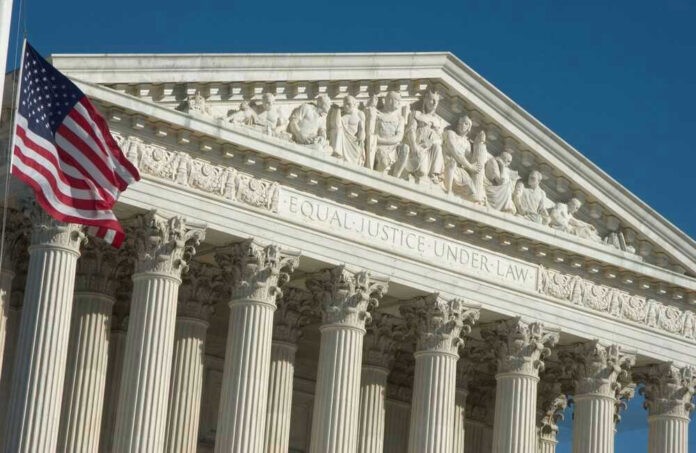
The Supreme Court just ruled that presidents can fire the heads of so-called “independent” federal agencies at any time — ending a 91-year legal fiction that let unelected bureaucrats operate beyond the reach of the voters who put the president in office.
Story Highlights
- The Supreme Court ruled 6-3 in Trump v. Slaughter that the president can fire Federal Trade Commission (FTC) commissioners at will, without needing a specific cause.
- The ruling overturned Humphrey’s Executor v. United States, a 1935 precedent that shielded independent agency heads from presidential removal for 91 years.
- Chief Justice John Roberts wrote that officers who exercise executive power must answer to the president — and through him, to the American people.
- The decision could affect other agencies, such as the Equal Employment Opportunity Commission (EEOC) and the National Labor Relations Board (NLRB), but leaves the Federal Reserve Board protected by a separate historical exception.
What the Court Actually Decided
On June 29, 2026, the Supreme Court ruled 6-3 in Trump v. Slaughter that the FTC Act’s “for-cause” removal protections are unconstitutional. The case began when President Trump fired two Democrat FTC commissioners — Rebecca Slaughter and Alvaro Bedoya — citing policy disagreements.
The fired commissioners sued, arguing that the law allowed removal only for inefficiency, neglect of duty, or misconduct. The Court sided with Trump.
Chief Justice Roberts wrote the majority opinion, stating plainly: “The President may remove his subordinates at will.” The Court found that FTC commissioners exercise real executive power — filing civil suits, writing binding rules, and deciding enforcement cases.
Because Article II of the Constitution places all executive power in the president, the Court said Congress cannot legally block him from removing those who wield that power. The “quasi-judicial” and “quasi-legislative” labels the 1935 court used were, in the majority’s words, a legal fiction.
A 91-Year Precedent Falls
The 1935 ruling in Humphrey’s Executor v. United States had long been the legal shield protecting independent agency commissioners from being fired without cause. That unanimous decision said the FTC performed duties that were not purely executive, so Congress could limit the president’s removal power.
For nine decades, independent agencies like the FTC, the EEOC, and the National Labor Relations Board (NLRB) operated under that protection. Thursday’s ruling dismantles it entirely.
6 conservative Supreme Court Justices have increased Trump's power over independent federal agencies.
This ruling allows Trump to fire Democratic appointee and former FTC Commissioner Rebecca Slaughter. pic.twitter.com/CDu1FKfuEg
— Headquarters (@HQNewsNow) June 29, 2026
The three liberal justices — Sonia Sotomayor, Elena Kagan, and Ketanji Brown Jackson — dissented sharply. Justice Sotomayor called the decision “grievously wrong,” and the dissent warned it hands the president “far greater power than ever before.”
Critics, including fired commissioner Slaughter, called the ruling a gift to corporate insiders. But those objections do not change the core legal outcome: the Court’s six-justice majority held that accountability to the president is required by the Constitution, not optional.
What This Means Going Forward
The ruling does not erase any agency’s legal authority. The laws these agencies enforce remain on the books, and their powers to regulate and investigate are unchanged. What changes is who controls the people running them.
Commissioners at multi-member independent agencies that exercise executive power can now be removed by the president for any reason. That includes agencies such as the EEOC and the NLRB, which could face similar legal challenges arising from this decision.
One notable exception emerged from a companion case, Trump v. Cook. The Court carved out a special historical protection for the Federal Reserve Board of Governors, leaving its members shielded from at-will removal.
For those who have long argued that unelected bureaucrats wield too much unchecked power, this ruling is a meaningful win. It restores a basic democratic principle: the people elect the president, the president directs the executive branch, and the executive branch answers to the people — not the other way around.
Sources:
npr.org, facebook.com, yalejreg.com, sidley.com