

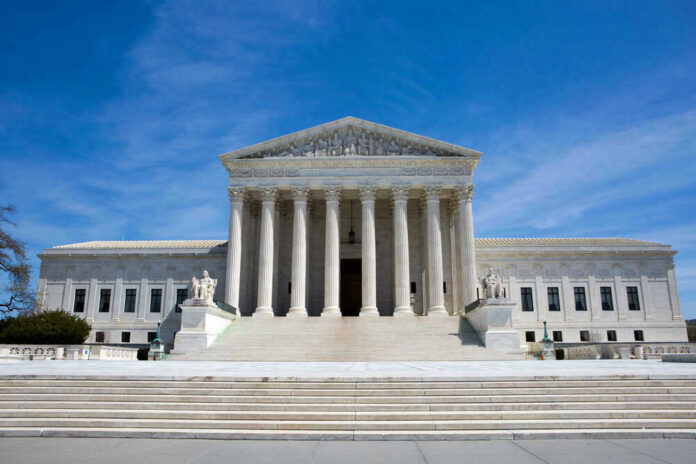
The Supreme Court just cleared the way for California’s voter-approved map designed to knock out GOP House seats—cementing a new era of mid-decade, tit-for-tat gerrymandering heading into the 2026 midterms.
Quick Take
- The Supreme Court denied an emergency request to block California’s new congressional map, meaning it will be used in the 2026 elections.
- California’s Proposition 50 was approved by voters in a special election and redraws 16 districts after Texas adopted a GOP-friendly map.
- Republican challengers and the Trump administration argued the California map amounted to illegal racial gerrymandering, but lower courts said racial evidence was weak compared with partisan motives.
- The Court’s brief order had no dissents, and the timing dispute centered on avoiding election disruption as campaigns ramp up.
Supreme Court lets Proposition 50 stand for 2026
On February 4, 2026, the U.S. Supreme Court issued a short, unsigned order declining to halt California’s new congressional map, approved by voters as Proposition 50. The immediate result is straightforward: the lines will govern the 2026 midterm elections.
California Republicans had sought an emergency stay after losing in lower court, and the Trump administration backed that request. The Court did not explain its reasoning and recorded no dissents.
Supreme Court allows new California congressional districts that favor Democrats https://t.co/LCji6EbGGk
— New York Daily News (@NYDailyNews) February 4, 2026
The stakes are national, not just local. The map is expected to tilt several House seats toward Democrats, potentially flipping up to five GOP-held districts according to reporting and filings summarized in the underlying coverage.
With House control frequently decided on narrow margins, a handful of seats in California can influence committee leadership, federal spending fights, and whether President Trump’s agenda can move through Congress without obstruction.
A partisan arms race triggered by Texas’s midcycle redraw
California’s move did not happen in a vacuum. In November 2025, Texas adopted a GOP-friendly map after President Trump urged the state to pursue additional Republican seats. California Democrats responded with a special election in which voters approved Proposition 50 with 64% support—about 11 million votes—explicitly redrawing 16 districts.
That sequence has fueled a wider redistricting escalation: when one large state changes lines mid-decade, another state now answers in kind.
That escalation matters because the constitutional and legal guardrails are narrow. Federal courts generally cannot police “partisan gerrymandering” after the Supreme Court’s 2019 ruling in Rucho v. Common Cause. That leaves challengers searching for another hook, typically racial gerrymandering claims under the Voting Rights Act and the Constitution.
The practical effect is that partisan motive can be politically explosive yet legally insulated—unless plaintiffs can prove race, not politics, predominated in drawing districts.
Racial gerrymandering claims face a high bar in the lower-court record
In the California litigation, challengers argued that Proposition 50 crossed the legal line by using race as the driving factor in key districts, including changes affecting Latino political power.
The Trump administration’s filing argued that partisan goals are not a “license” for racial gerrymandering and pointed to allegations about a consultant map-drawer and shifts in district demographics described in the court fight. California countered that the map was a voter-approved initiative and warned against late-stage disruption.
A three-judge federal panel in Los Angeles upheld the map in a 2–1 decision, and the majority’s language is a problem for the challengers at this emergency stage. U.S. District Judge Josephine Staton wrote that evidence of racial motivation was “exceptionally weak,” while evidence of partisan motivation was “overwhelming.”
The panel also rejected the idea that lawmakers and voters were unwitting “dupes” for a race-driven scheme. With that record, the Supreme Court’s refusal to intervene now is easier to understand.
Purcell timing and election administration drove the urgency
California’s defense leaned heavily on the Supreme Court’s “Purcell principle,” which cautions against last-minute court changes that can confuse voters and disrupt election administration. Candidate activity was already underway; signature collection for candidates reportedly began December 19, 2025, and campaigns were operating under the newly adopted lines.
The Supreme Court has previously treated timing as a decisive factor, even when justices signal discomfort with the underlying policy choices, because altering maps late can throw an election into chaos.
Constitutional concerns: elections becoming another arena for raw power
For voters who care about constitutional stability and equal representation, the bigger takeaway is not which party benefits in 2026—it’s that mid-decade line drawing is becoming normalized. When redistricting stops being a once-a-decade reset and becomes a rolling political weapon, public trust takes the hit.
The Court has effectively signaled that, absent clear racial proof, these fights are political questions with limited federal remedies, leaving states to escalate rather than de-escalate.
The Supreme Court on Wednesday allowed California to use a new voter-approved congressional map that is favorable to Democrats in this year’s elections, rejecting a last-ditch plea from state Republicans and the Trump administration.https://t.co/BnDdejrX7I
— FOX26 News (@KMPHFOX26) February 4, 2026
Republicans say they intend to keep fighting, but this order locks in the immediate battlefield: the 2026 midterms will be run on Proposition 50’s lines. That means the contest shifts from courtrooms to campaign strategy—candidate recruitment, messaging, turnout operations, and ballot integrity efforts that can withstand aggressive rule-lawyering.
Limited public information is available on any post-order developments beyond the Court’s denial, so the next major inflection point will likely come only if a full merits appeal reaches the Court later.
Sources:
Supreme Court allows new California congressional districts that favor Democrats
The Supreme Court lets California use its new Democratic-friendly congressional map
2025 California Proposition 50
California asks Supreme Court to reject GOP map challenge