

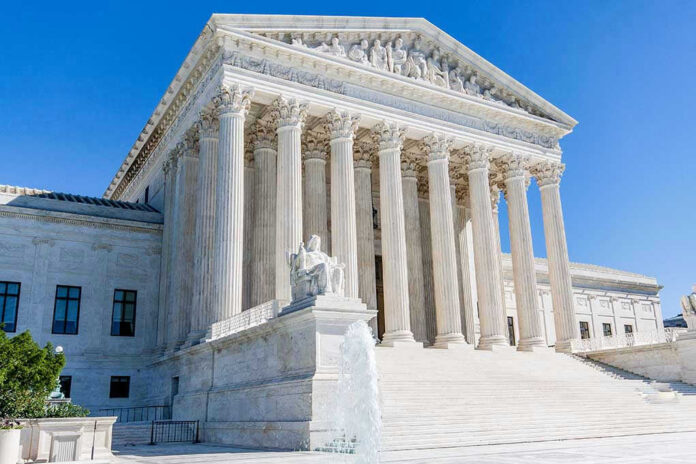
The Supreme Court just told every green card holder that a mere criminal accusation can turn a routine trip abroad into a one-way ticket to “immigration limbo.”[6]
Story Snapshot
- Supreme Court ruled 6-3 for the Trump administration in the Muk Choi Lau immigration parole case.[6]
- Border officers do not need “clear and convincing” proof of a crime to treat a green card holder as an applicant for admission.[7]
- The administration argued that suspicion of criminal activity alone can justify placing a lawful permanent resident on immigration parole.[6]
- This ruling fits a broader pattern of courts giving wide leeway to presidents on immigration enforcement and parole.[8][13]
The case that turned a short trip into a high-stakes test of government power
Lawful permanent resident Muk Choi Lau left the United States for a brief trip to China in 2012 while facing a counterfeiting accusation in New Jersey.[6]
When he returned, a border officer did something most green card holders assume cannot happen without a conviction: the officer put him on immigration parole and treated him as an “applicant for admission,” not as a settled resident.[6] That single decision made it much easier for the government to move toward removing him if the criminal case went badly.
Supreme Court sides with Trump admin in green card holders immigration case https://t.co/qQtteQfX2Z pic.twitter.com/XN5A5FAncj
— New York Post (@nypost) June 23, 2026
Lau later pleaded guilty to selling counterfeit clothing, and the Department of Homeland Security under President Barack Obama used his parole status to pursue removal.[6] Lau argued that the officer had overstepped and that the law required much stronger proof before stripping a lawful permanent resident of the protections that come with a green card.[6]
His lawyers said the government should have to show “clear and convincing” evidence that he had committed a crime involving moral turpitude, which is a serious offense showing bad character. The Supreme Court rejected that argument.[7]
What the Supreme Court actually decided about suspicion, evidence, and officer power
The Court, by a 6-3 vote, sided with the Trump administration and the officer.[6] Justice Clarence Thomas wrote that border officers “did not have the burden to establish by clear and convincing evidence that Lau had committed a crime involving moral turpitude” before treating him as an applicant for admission.[6][7]
In plain terms, the majority said Congress never imposed a high proof standard on officers making rapid calls at the border, and they refused to read that requirement into the Immigration and Nationality Act.[7]
The Trump administration went further, arguing that suspicion of a crime is enough to justify putting a green card holder on immigration parole.[6] The Court’s opinion embraced that relaxed threshold by focusing on allegations and the need for fast decisions, not on convictions or detailed evidence.[7]
At the same time, the Court did not decide whether Lau’s counterfeiting offense truly qualifies as a crime involving moral turpitude under immigration law, leaving that technical question to lower courts.[7][8] So the big takeaway is about power and standards, not about the label on his specific crime.
Why this matters for lawful permanent residents who think they are “safe”
This ruling quietly rewrites the mental script many long-time residents rely on. Green card holders often believe that unless they are convicted of a serious crime, their status is secure when they travel.
The Court has now said that a pending accusation can be enough for border officers to parole them and treat them as if they are asking to enter the country anew.[7] That shift lowers the bar for the government to start removal proceedings and raises the risk of every foreign trip taken while any criminal issue is unresolved.
Justice Ketanji Brown Jackson’s dissent warned that this choice can put people like Lau into “immigration limbo” before they have been convicted of anything.[6]
Her phrase captures the concern with fairness: government power should not get a “massive blank check” to disrupt the lives of people who followed the legal path into the country but now face unproven allegations. Yet the majority saw speed and border control as more important than a higher proof standard, and that view now governs.
The larger pattern: courts leaning toward broad presidential control over immigration
This case does not stand alone. It fits a bigger pattern in which courts have steadily favored strong executive control over immigration rules and parole programs.[8] The Supreme Court recently allowed the Department of Homeland Security to end humanitarian parole for more than 500,000 migrants from Cuba, Haiti, Nicaragua, and Venezuela, without requiring case-by-case review.[13][14]
A federal appeals court then backed that mass termination, confirming that broad policy decisions can override individual expectations built on prior programs.[15]
Do you understand how important this ruling is?
This just massively sped up the “process” of deportation.
“A federal appeals court handed President Donald Trump a significant win in his mass deportation efforts with a ruling Tuesday reviving his administration’s move to speed…
— JoeLange (@JoeLange) June 23, 2026
This trend reflects a belief that elected branches, not unelected judges, should control who is allowed to enter and remain in the country. Strong borders, quick decisions, and clear authority line up with common sense concerns about crime and national security.
The risk, which critics highlight, is that when suspicion is enough and individualized review fades, the system can punish people on thin evidence or political pressure. This ruling pushes the balance further toward power at the border and away from courtroom-style safeguards.
Sources:
[6] Web – Cases – Permanent residence – Oyez
[7] Web – Immigration & National Security Supreme Court Cases
[8] YouTube – What it Means for Your Removal Case [With Live Q&A]
[13] Web – The Supreme Court sided with the Trump administration Tuesday in …
[14] Web – Todd Blanche, Acting Attorney General, Petitioner v. Muk Choi Lau
[15] Web – Supreme Court allows DHS to end parole for a half-million noncitizens