
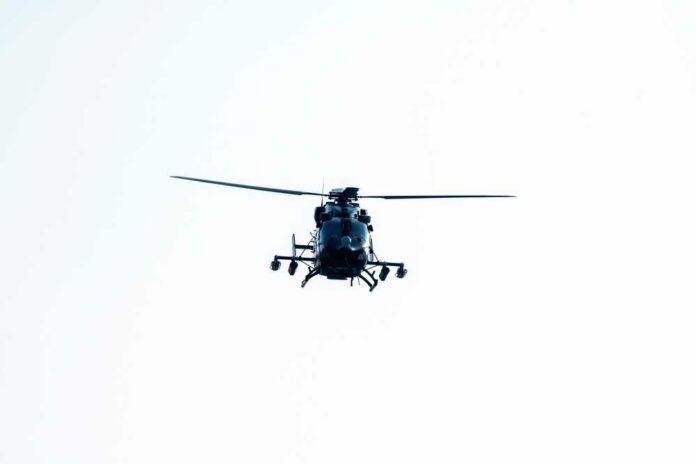
Two soldiers died Wednesday when their Army Apache helicopter went down in a field near Salado, Texas, sparking a grass fire that grew past 100 acres and forced families from their homes.
Story Snapshot
- An AH-64 Apache attack helicopter based at Fort Hood crashed near Salado, Texas, killing both soldiers on board.
- The Bell County Sheriff’s Office got a 911 call about the crash shortly after 1:30 p.m.
- The crash sparked a grass fire that grew past 100 acres and closed a nearby road.
- The helicopter came down in an open field and did not hit any homes or buildings.
- The cause of the crash remains under investigation.
What Happened In The Field Near Salado
The Army confirmed the aircraft was an AH-64 Apache, a two-seat attack helicopter based at Fort Hood. It went down in a field outside Salado, a small town in Bell County about halfway between Austin and Waco. Both soldiers on board died.
Bell County Sheriff’s Office spokesman Cliff Coleman called it “a violent crash,” a blunt description that matches the scale of destruction first responders found at the scene.
Two people were killed when a U.S. Army Apache helicopter from Fort Hood crashed in Salado, Texas, on Wednesday, local authorities said. https://t.co/dvVsSE11DW pic.twitter.com/0GpBMFBSKd
— CBS Evening News with Tony Dokoupil (@CBSEveningNews) August 12, 2026
The sheriff’s office says it received the first 911 call about the crash around 1:33 p.m. Deputies, firefighters, and Army personnel from Fort Hood converged on the site within minutes.
Coleman told reporters the helicopter missed nearby houses and other buildings, a detail that likely spared additional lives given how close rural homes sit to open fields in that part of Central Texas.
Fire Grows While Roads Shut Down
The impact ignited a grass fire that spread fast through dry brush. Firefighters from Salado, Jarrell, and both the Eastside and Westside departments responded to keep it from reaching nearby neighborhoods.
By mid-afternoon the blaze had grown past 100 acres and remained uncontained, forcing officials to evacuate several homes as a precaution.
Farm-to-Market Road 2843, a key route through the area, became impassable as crews worked the fire line and secured the crash site. Local reporting also noted shifting numbers on acreage and containment as the afternoon wore on, which is typical in the fast-moving first hours after any major crash and fire.
Why The Investigation Will Take Time
Fort Hood’s Criminal Investigation Division is expected to lead the inquiry into what caused the crash, a process that typically involves flight logs, maintenance records, and wreckage analysis before any official cause is released.
Neither the Army nor local officials have offered a theory on what went wrong, and that silence is appropriate. Rushing a cause before the evidence is in would do a disservice to the families of the soldiers who died.
What is not in dispute is the sequence of events on the ground: the aircraft type, its Fort Hood affiliation, the two deaths, the location, and the resulting fire have all been confirmed by the Army and Bell County officials and repeated consistently across multiple news outlets.
That consistency matters. When military and local law enforcement align on the basic facts within hours of a tragedy, the public deserves to trust that baseline account while the harder questions get worked out through proper channels.
A Community That Understands The Cost
Salado sits close enough to Fort Hood that military families are neighbors, not strangers. Crashes like this one land hard in towns built around service members and their sacrifice.
Two soldiers strapped into an Apache that day did not come home, and the community response, from firefighters to sheriff’s deputies to state lawmakers who’ve since spoken out, reflects a shared understanding of what that loss means.
Officials with Fort Hood confirmed that the crash in Salado involved an AH-64 Apache attack helicopter based at the installation. https://t.co/IGDavtoQ0L
— THV11 (@THV11) August 13, 2026
The Army has not yet released the names of the soldiers killed, following standard procedure that gives families time to be notified before any public identification.
Fort Hood, one of the largest military installations in the country, will likely hold a memorial once that process concludes. For now, the field outside Salado stands as a quiet reminder of the risks these aircrews accept every time they climb into the cockpit.
Sources:
cbsnews.com, abcnews.com, cnn.com, timesnownews.com, youtube.com