
For a few tense minutes over Washington, the system built to shield President Trump from danger failed one simple rule: stop the other planes.
Story Snapshot
- Marine One took off with President Trump while commercial flights still moved at Reagan National Airport, against protocol.
- A passenger jet departed seconds later, leading to a reported “loss of separation” between the two aircraft.
- Federal Aviation Administration (FAA) officials say there was no collision risk and the president was never in danger.
- The incident exposed how a safety policy created after a deadly 2025 crash can still break down.
The moment Marine One met a moving sky
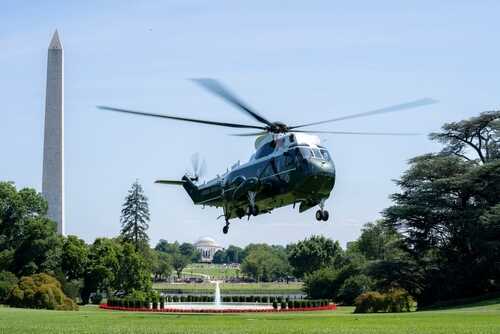
On Tuesday afternoon, Marine One lifted off from the Ellipse just south of the White House with President Trump on board, headed to Joint Base Andrews for a trip to Los Angeles. At almost the same time, an Envoy Air regional jet rolled down the runway at Ronald Reagan Washington National Airport, bound for Pensacola, Florida.
Those two facts alone should not happen together. Under the rules written after a fatal 2025 midair collision, commercial traffic is supposed to stop when Marine One launches.
Reports say air traffic controllers had not halted those commercial flights at Reagan National, even though the protocol required it.
That policy grew out of a tragedy: an American Airlines regional jet and a United States Army helicopter collided near the same airport in January 2025, killing 67 people and forcing regulators to admit that mixed civilian and military traffic in tight airspace needs strict timing.
When Marine One rose while a passenger jet also climbed, it reopened that wound and raised hard questions about whether lessons were truly learned.
What the FAA says happened in the air
The Federal Aviation Administration quickly called it a “safety incident” and said it is reviewing the event. Officials described a “momentary loss of separation,” meaning the gap between Marine One and the Envoy jet dipped below the standard of at least 1.5 miles horizontally and 500 feet vertically near airports.
They stressed the aircraft were not converging and did not appear “dangerously close” under federal rules. In their words, it was not a dangerous close call, and the president was never in jeopardy.
Tuesday 'safety incident' with Marine One flight carrying Trump under investigation
Air traffic at nearby Reagan National Airport wasn’t stopped despite chopper take-off
'At NO point was the President in harm’s way' — White House pic.twitter.com/HZRd4j9GcL
— RT Intl (@RT_on_X) August 5, 2026
The controller handling the traffic stayed in contact with both pilots during the incident, according to FAA statements shared in broadcast reports. Both aircraft later landed without incident. From a technical standpoint, that matters.
Aviation safety experts often point out that many incidents involve rule breaches that never become true emergencies because crews and controllers still keep options open. However, the very term “loss of separation” exists because the system is supposed to prevent even brief dips below the safety margin.
Inside the tower: audio that tells a sharper story
Local television reporting and air traffic control audio reviewed by Washington’s 7News paint a less tidy picture. The tapes capture multiple calls from Marine One’s crew announcing they were “three minutes to lift” as they tried to coordinate with the tower.
At one point, the controller’s response was described as broken and unreadable in secondary reporting, suggesting the timing and communication were not clean. A jet then departed, and warnings followed about traffic already airborne as the presidential helicopter proceeded “as briefed.”
The FAA has launched an investigation into the failure to halt commercial flights at Washington Reagan National Airport during the takeoff of Marine One carrying President Donald Trump.https://t.co/zcU204nCoB pic.twitter.com/8KDQMzy2wn
— Ally Daily (@allydailycom) August 6, 2026
To many Americans, that sounds less like a smooth ballet and more like a scramble. For a White House flight, that disconnect feels troubling. The policy is simple: stop commercial traffic, launch Marine One, then resume.
When the basic rule breaks, it hints at either a controller mistake, a rushed sequence, or a system that tolerates sloppiness until something goes wrong. So far, public reporting does not pin the lapse on a named person or a clear cause.
Risk, politics, and common sense
This is where the gap between technical language and public instinct shows. Regulators say “not dangerously close,” “not converging,” and “momentary loss of separation.” Headlines shout “near crash,” “close call,” and “security scare.”
The reality likely sits between those extremes. There is solid evidence of a protocol violation and separation loss. There is also an official record saying the aircraft did not approach a collision course and the president was not at risk.
The core issue is not drama but discipline. Government sets rules after deadly failures; citizens expect those rules to be followed, especially when they protect both a president and ordinary passengers.
A system that allows a regional jet to depart while Marine One is about to lift, right after a 67-death collision prompted strict limits, looks like a bureaucracy that talks tough about safety but cuts corners when busy.
The investigation and what still needs answers
Reuters reports the FAA plans to convene a formal Safety Review Team to dig into radar data, controller actions, and routing decisions around the event. That is the right next step, but it is also the bare minimum.
To fully understand what went wrong, investigators will need to examine the tower’s timeline, the reasons commercial traffic was not halted, and whether this departure pattern has happened before during presidential flights.
So far, no controller, supervisor, or pilot has gone on the record saying they believed a collision was imminent. That lack of named testimony makes it harder for critics to claim the president faced grave danger. It does not erase the rule breach.
For many, the takeaway is simple: systems are only as strong as the people and procedures that enforce them. Moments like this reveal whether Washington is serious about safety or only serious after something explodes on the evening news.
Sources:
wsj.com, nbcnews.com, reuters.com, youtube.com, foxnews.com