

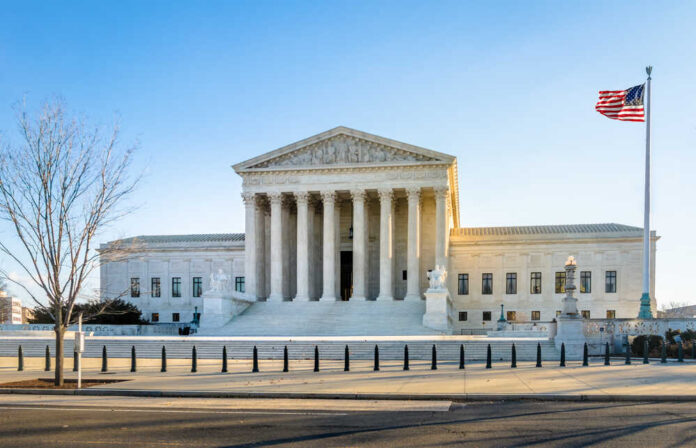
The Supreme Court shut the door—twice—on efforts to erase a $5 million judgment against President Trump in E. Jean Carroll’s civil case.
Story Snapshot
- A New York jury found Trump liable for sexual abuse and defamation and awarded $5 million.
- The Supreme Court declined review, leaving the verdict intact; no dissents were noted.
- A follow-up request to reconsider was also rejected without explanation.
- The United States Court of Appeals for the Second Circuit affirmed the verdict and evidence rulings.
What the Jury Decided and Why It Stuck
A Manhattan federal jury in 2023 found Trump liable for sexual abuse and defamation tied to a mid-1990s incident and a 2022 Truth Social post. The jury did not find rape but did find sexual abuse and awarded $5 million in total damages.
Trump denied Carroll’s account and called the suit a hoax, but the verdict rested on the jury’s view of credibility and the record admitted at trial. That civil judgment has now withstood every appellate punch thrown at it.
Supreme Court again rebuffs Trump in $5M E. Jean Carroll case https://t.co/8oKlAF3wut pic.twitter.com/hge04FPI1f
— New York Post (@nypost) August 17, 2026
The United States Court of Appeals for the Second Circuit upheld the trial court’s evidentiary calls, including admission of certain prior-acts material under the federal evidence rules that address sexual misconduct.
The court found no reversible error and affirmed the full $5 million award. That ruling cemented the case before it even reached Washington, signaling a fact-bound dispute that appellate judges do not disturb absent clear mistakes.
What The Supreme Court Did—and Did Not—Say
The Supreme Court denied review in June 2026, issuing a short order with no noted dissents. The Court later rejected a request to reconsider, again without explanation. A denial of review leaves the lower court’s decision in place.
It does not add new reasoning or create national precedent. It simply means at least six justices saw no need to step in. For this verdict, that ended Trump’s path to overturn it.
Some will try to spin a denial as a shrug on the merits. That misreads how the Court works. The justices decline hundreds of petitions each term. They reserve full reviews for split rulings, novel questions, or clear legal errors. None of that changed the outcome here.
The judgment stands, the money stands, and the liability finding stands, because the jury and the lower courts did their jobs within the rules.
Trump’s Denials Versus the Record
Trump has repeatedly denied Carroll’s claims, calling them false and a hoax, and saying she was not his type. He also blasted the case online after the Supreme Court denials. Those statements echo the lines that fueled the defamation finding in the first place.
Courts did not credit those denials over the proof at trial. Jurors heard Trump’s taped deposition and still ruled for Carroll, and appellate judges found no reason to upset that call.
BREAKING: The U.S. Supreme Court has REJECTED Trump’s renewed request to hear his appeal of the $5 MILLION verdict in favor of E. Jean Carroll.
The nation’s highest court has once again refused to intervene.
Trump loses again. pic.twitter.com/mehd5WzNzK
— Darline Graham Q🇺🇸 (@DarlinGrahamSC) August 18, 2026
Trump’s lawyers argued the trial judge allowed evidence that unfairly swayed jurors. The Second Circuit rejected that claim after a full review of the record and relevant evidence rules, concluding the rulings were within the court’s discretion.
Trials have rules. Appeals check those rules. If the process is clean and the jury’s role respected, the verdict should stand—even when it involves a sitting president.
Why This Outcome Fits the Larger Legal Pattern
Defamation cases often turn on credibility and careful evidence calls. Appellate courts rarely disturb those fact-heavy judgments unless a legal error is obvious. The Court’s refusal to take this case is consistent with that pattern.
Denials of review do not bless every fact below; they confirm the system does not need the Supreme Court’s hand on it. The practical effect is simple and final: the $5 million verdict remains enforceable, and the litigation chapter on this case is closed.
Sources:
apnews.com, abcnews.com, theguardian.com, cnbc.com, scotusblog.com, en.wikipedia.org