
One short sea lane has become the center of a wider fight over power, trade, and blame.
Quick Take
- The United States says it struck Iran after attacks on commercial vessels in the Strait of Hormuz.
- Tehran says the attacks were either not its doing or were a reply to U.S. pressure.
- The fight has spread beyond the waterway, with Iran retaliating across the region.
- Both sides are trying to control the story as much as the strait.
How the Strait Became the Flashpoint
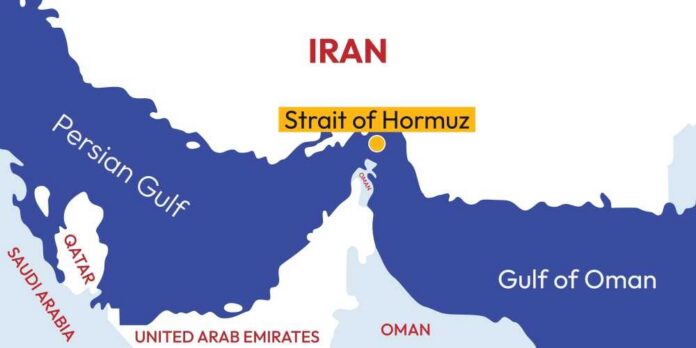
The Strait of Hormuz sits at the center of global energy traffic, so every strike there has outsized weight. In the latest round, the United States launched new attacks on Iran after commercial ships were hit, and the White House framed the move as a push to restore control over the waterway. That turns a military clash into a test of who gets to decide what “free passage” means.
President Donald Trump said the United States was “reinstating” a blockade on Iran in the strait and would “put the blockade back.” He also said the agreement reached last month had not been honored.
U.S. Central Command said its action was a response to attacks on commercial shipping and a way to degrade Iran’s ability to interfere with navigation. That language matters because it casts the strikes as defensive, not optional.
The U.S. Case and the Force Behind It
The American case rests on an official chain of blame. Reuters reported that the United States attacked Iran in response to an Iranian drone strike on a cargo ship, while U.S. Central Command called the conduct “unwarranted aggression” against commercial shipping.
BBC and other outlets also described the episode as a back-and-forth exchange, which reflects how fast the conflict moved from one ship attack to a wider military response.
US and Iranian forces exchanged heavy missile and drone assaults, with Tehran targeting US facilities in states across the Gulf and saying it had again closed the vital Strait of Hormuz, sending oil prices higher https://t.co/VDrfSYhSGd
— Reuters (@Reuters) July 13, 2026
What makes this round different is the scope. CBS News reported that Iran later retaliated against countries across the Middle East, which shows the conflict did not stay inside the strait. That is the dangerous part of maritime crises. A single hit on a tanker can become a regional signal fight. Once that happens, every actor starts reading every move as a warning to everyone else.
Tehran’s Denial and Counter-Story
Iran’s answer was not simple silence. BBC reported that the Iranian Foreign Ministry condemned the U.S. strikes and said Washington was breaking promises and violating the ceasefire. Reuters likewise noted that each side accused the other of violating the terms of the truce. Iran also argued that ships were using an unauthorized route, which it said made the American retaliation illegitimate.
🇺🇲🇮🇷Ex-CENTCOM Chief Urges US to Seize Iran's Kharg Island – Key to 90% of Its Oil Exports
Retired Gen. Frank McKenzie, former head of US Central Command, said on CBS's Face the Nation that the United States should consider seizing Iran's Kharg Island.
The small island handles… pic.twitter.com/YqhC6qqavH
— Global Surveillance (@Globalsurv) July 14, 2026
That denial matters because it keeps the legal and political fight alive. If Iran can frame the tanker attacks as a reply to U.S. pressure, then the story changes from “aggression” to “reprisal.” AP reported that Tehran said it fired on three outbound ships and seized two, calling it retaliation for the American naval blockade and for U.S. actions at sea. That is a direct challenge to the American version of events.
Why the Evidence Fight Still Matters
The strongest public evidence in the available reporting is not a forensic report. It is the official attribution from the two governments and the military commands involved.
That leaves room for argument, especially because the public record here does not include a full technical investigation of the weapons or wreckage. In plain terms, the side with the loudest microphone still has not produced the kind of proof that settles the matter for skeptics.
Still, the pattern is familiar. United States policy officials have said Iran has long used small boats, drones, and missiles to pressure shipping in the region. That history makes the U.S. case easier to believe for many observers, even if it does not replace hard proof. This is why the story keeps coming back to the same question: who started it, and who can prove it?
What the Region Pays
The human and economic cost is immediate. BBC reported that traffic through the Strait of Hormuz fell sharply after the strikes, dropping from 41 ships to 7. That kind of collapse is not just a shipping problem. It is a global price problem. It threatens insurers, shippers, refiners, and every country that depends on stable energy flows. The strait is narrow, but its consequences are wide.
That is why the political rhetoric sounds so blunt. Trump described Iran as a violator of the truce and said the United States was hitting it hard. Critics will call that swagger. Supporters will call it clarity. Either way, the message is unmistakable. Washington wants to make the cost of attacking shipping so high that Tehran thinks twice before testing the strait again.
Sources:
apnews.com, nytimes.com, reuters.com, foxnews.com, youtube.com, pbs.org, aljazeera.com, en.wikipedia.org, bbc.com, cfr.org, maritime.dot.gov